

OpenAI has unveiled Prism, a free scientific writing tool powered by GPT-5.2.
The service is available to all registered users. It allows researchers to typeset scientific papers and journals in LaTeX, including formulas and diagrams, as well as to search for academic literature and automatically generate bibliographies.
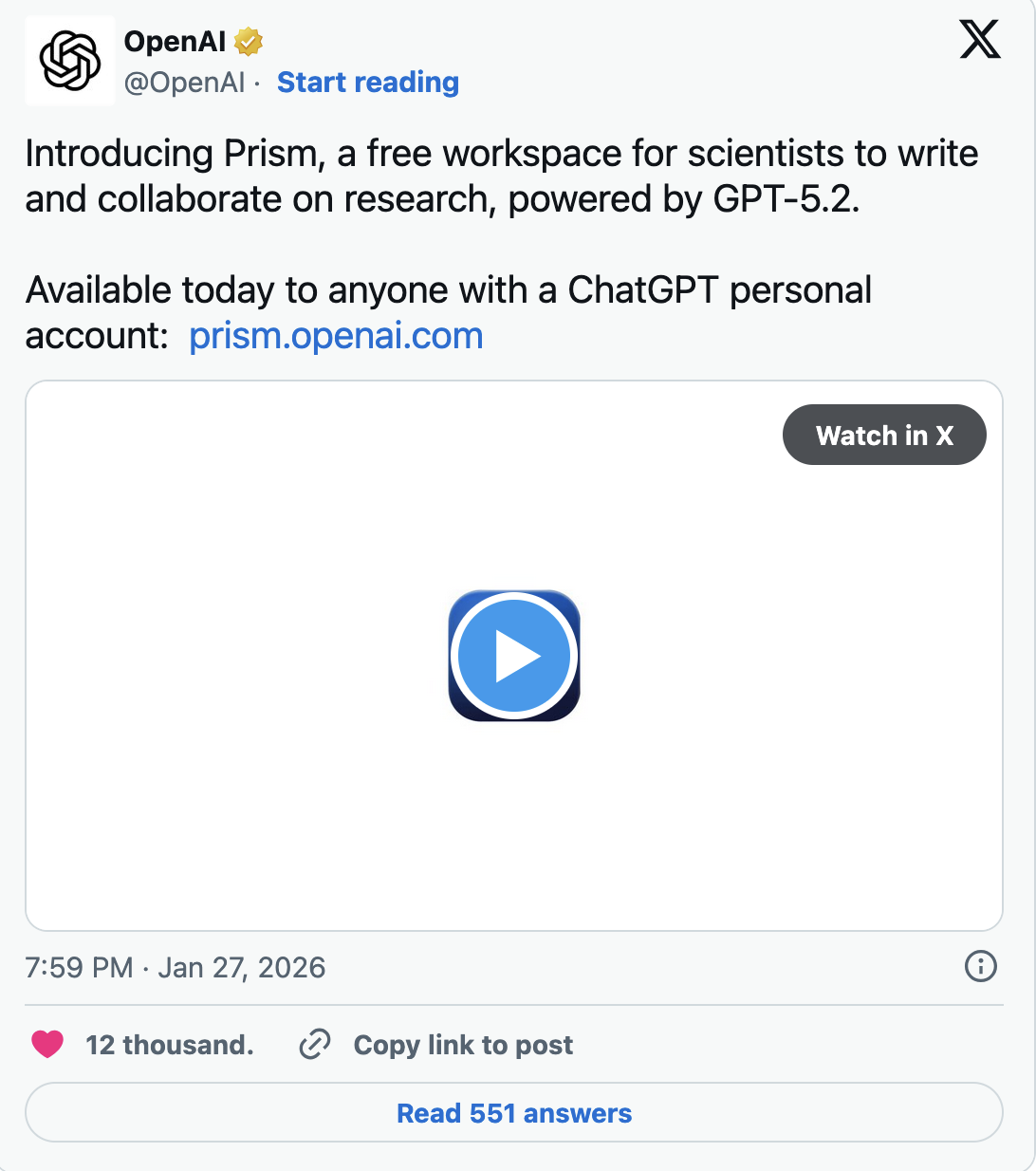
Developers position Prism as an assistant rather than a replacement for researchers. The company believes the tool will significantly accelerate scientific work and compares it to Cursor and Windsurf.
“I think 2026 will be for AI and science what last year was for artificial intelligence and software engineering,” said Kevin Weil, OpenAI’s Vice President of Science, in a press release.
Access to the new application is provided via a web interface.
OpenAI also highlighted the growing interest in scientific computing: ChatGPT now processes 8.4 million complex science-related queries every week. How many of these come from professional researchers remains unknown.
Neural networks are increasingly becoming working tools for scientists. In mathematics, models have been used to prove several long-standing problems posed by Paul Erdős, combining analysis of existing literature with new approaches.
A paper published in December 2025 reported that GPT-5.2 Pro helped discover new proofs of the central limit theorem, with human involvement limited mainly to prompt input and result verification.
OpenAI emphasized these results in a blog post, pointing to the vast potential of human–AI collaboration.
“In fields with axiomatic theoretical foundations, advanced models can help explore proofs, test hypotheses, and uncover connections that would otherwise require significant human effort,” the company said.
Prism’s capabilities
A key feature of OpenAI’s new system is its seamless integration with established standards. Prism works natively with LaTeX, the open-source system widely used for formatting and typesetting scientific papers.
The platform also leverages the visual capabilities of GPT-5.2, allowing users to build diagrams from sketches on an online whiteboard.
One of its most powerful features is the combination of standard AI capabilities with strict context management. When working in Prism, the model analyzes the entire research project, making its responses more accurate and context-aware.
OpenAI expects the intuitive interface to attract the scientific community.
“Software engineering accelerated partly thanks to powerful models and partly due to deep workflow integration,” Weil noted.
With Prism, researchers can:
-
brainstorm ideas and test hypotheses with GPT-5.2 Thinking;
-
edit manuscripts with full awareness of document context, including formulas and structure;
-
find relevant literature and refine text by identifying related work;
-
analyze and connect equations, citations, and figures across the entire document;
-
convert equations or diagrams from a whiteboard directly into LaTeX;
-
collaborate in real time with co-authors, students, and supervisors;
-
make edits directly in the document without switching between windows;
-
use voice commands for rapid editing.
Prism is built on Crixet, a cloud-based LaTeX platform that OpenAI acquired and modernized.




 ES
ES  EN
EN