
Artificial intelligence could, in theory, help solve all of humanity’s problems. Stop wars, cure diseases, overcome poverty, and settle other planets. That’s what optimists believe. Pessimists, meanwhile, recall machine uprisings, The Matrix, and other post-apocalyptic visions: we’re all doomed.
But what about reality? Instead of “robots do the work, humans enjoy life,” we have the opposite. You have to clear the floor before the robot vacuum can clean, while pleasant creative work once done by designers and writers is being taken over by soulless machines. A vivid recent example is Sora — a kind of AI TikTok (still with limited access), where short videos no longer need to be filmed or edited, because the neural network does it for you. Has humanity lost its mind?
No. Calm down. There’s nothing new here. Humanity has made foolish choices with new technologies before.
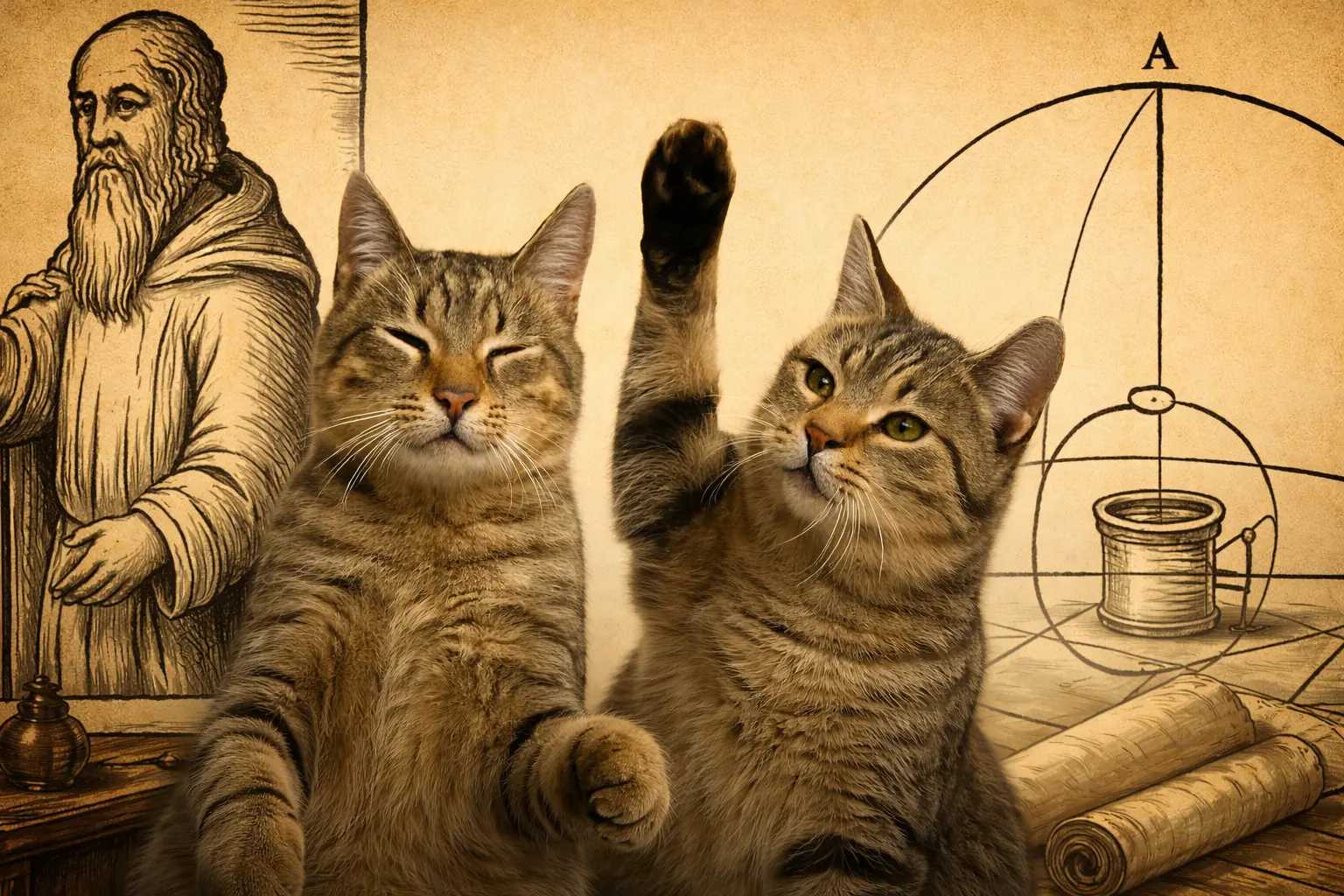
1894. Progressive circles are thrilled by the ability to capture moving objects on film. The technology is complex and far from mass-market. What should we film? Educational videos? Preserve artistic and technical achievements for future generations? No — a better idea: film boxing cats from Professor Welton’s cat circus.
The 1740s. Experiments with electricity reveal, for the first time, that it can be stored in primitive capacitors (Leyden jars). Serious electrical engineering must be just around the corner, right? What does the French king Louis XV do? Exactly — he invites the prominent scientist Jean-Antoine Nollet to court to entertain the public with amusing experiments. For example, electrifying the hair of a boy suspended from the ceiling, or passing current through a chain of two hundred monks.
The first century AD. The Greek scientist Hero of Alexandria invents the aeolipile — an actual steam turbine. That’s it! Steam engines, generators, full-blown steampunk Ancient Greece! But for some reason, it didn’t happen. Hero’s device remained a curious toy. Steam turbines for practical use were built almost two thousand years later, in Victorian times.
Do you see the pattern? When inventing something new and revolutionary, humanity repeatedly starts by treating the technology as a toy. Only later, through trial and error, does it find the most meaningful applications.
Let’s hope artificial intelligence helps cure cancer sooner than the two thousand years humanity might otherwise spend watching dances of computer-generated cats



 ES
ES  EN
EN