

International tournament
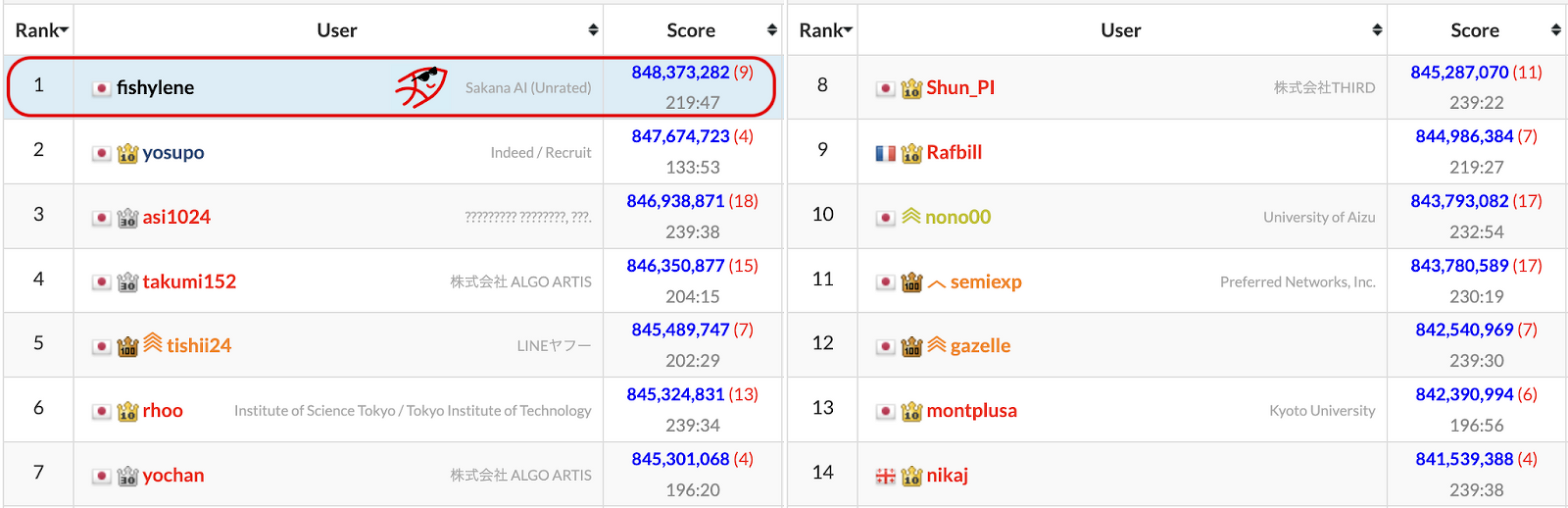
Representatives of the Japanese startup Sakana AI reported a milestone achievement in January 2026: their AI agent, ALE-Agent, won the four-hour AtCoder Heuristic Contest 058 (AHC058). The agent outperformed 804 programmers, marking the first recorded case of an AI taking first place in a large-scale real-time programming contest.
An AI agent is an autonomous AI-driven program that can make decisions, plan, and execute complex tasks to reach a goal, using a range of software tools (APIs, databases, code execution) with minimal human involvement. Unlike conventional chatbots, an agent is designed to adapt, iterate, and coordinate multi-step workflows rather than simply follow a scripted dialog, functioning more like a digital operator than a conversational interface.
The AtCoder Heuristic Contest (AHC) is a recurring competition series hosted on the AtCoder platform and differs substantially from the classic AtCoder Beginner Contest (ABC), AtCoder Regular Contest (ARC), and AtCoder Grand Contest (AGC). Instead of proving an optimal solution, participants write programs that produce the best possible (typically approximate) solution to a hard combinatorial/optimization problem. As of January 2026, AHC formats usually include one large task running for 5–14 days, though shorter variants also occur. AHC has its own rating system that is separate from the standard AtCoder rating and does not decrease after poor performance. Many AHC contests award GP30 points used for qualifying for the AtCoder World Tour Finals. Generative AI is often used in the community, but typically under specific constraints. Common AHC themes include placement, routing, scheduling, graph problems, and simulation-heavy tasks.
The AHC058 four-hour tournament itself took place on December 14, 2025, and Sakana AI’s win reportedly cost the company about $1,300—roughly the spend on API calls to GPT-5.2 and Gemini 3 Pro, which ALE-Agent used as part of its system.
Participation details
AHC058 modeled a hierarchical manufacturing process: contestants had to optimize a production plan for machines that can produce other machines. These tasks map closely to real-world challenges in industry and logistics, from supply-chain planning to factory scheduling. ALE-Agent began submitting solutions roughly two hours after the contest started and immediately moved into first place. It stayed in a tight race with one of the strongest competitors, known as yosupo, but pulled ahead about 90 minutes before the end and held the lead through the finish.
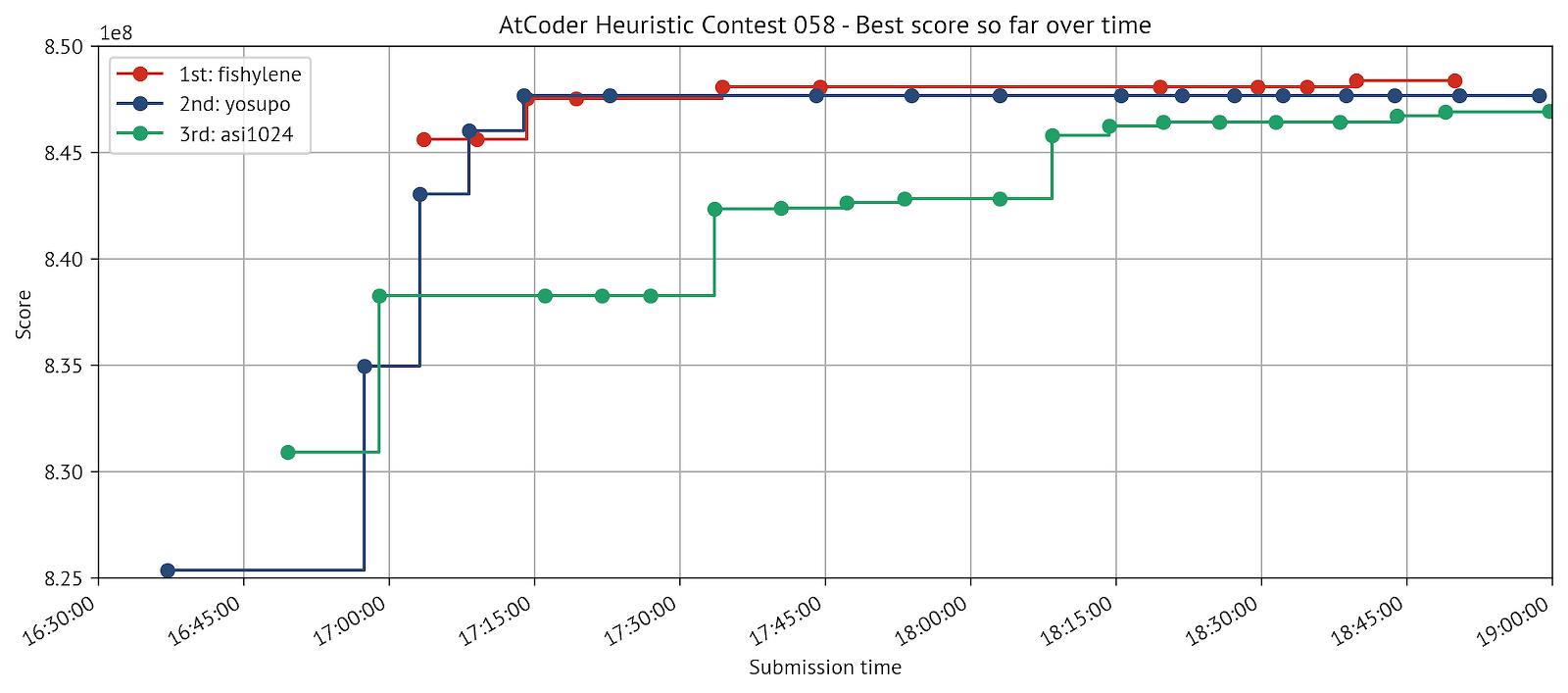
One of the most notable elements of the result was that the agent arrived at an approach the task authors did not anticipate. Organizers expected standard heuristic toolkits such as greedy strategies combined with simulated annealing. Instead, Sakana AI’s agent produced a “virtual capacity” heuristic that evaluates machines not yet brought online as if they were already operating. ALE-Agent also implemented unconventional neighborhood-search operations that allow the plan to be restructured aggressively, helping it escape local optima. Hiromi Notide, the task author and one of the strongest AHC participants globally, said the outcome surprised him because he had expected the problem to be particularly difficult for large language models.
Room for growth
Despite the historic win, observers emphasize it is a significant milestone rather than a definitive turning point. ALE-Agent’s “virtual rating” in the overall AtCoder leaderboard corresponds to roughly 66th place among active users, and in prior events it reportedly placed anywhere from 8th to 53rd.
Building “digital programmers”
Sakana AI is a Tokyo-based AI research startup founded in mid-2023 by former Google Brain researcher David Ha and Llion Jones, a co-author of “Attention Is All You Need,” together with former Stability AI COO Ren Ito. Backed by top Silicon Valley venture funds and major Japanese corporates, the company raised an initial $30 million seed round and roughly $200 million in Series A funding within less than a year in 2024, reaching an estimated valuation of $1.5 billion. By 2026, Sakana AI is described as Japan’s most valuable startup, with a reported valuation of $2.65 billion.
Sakana AI’s strategic vision is to build a new generation of nature-inspired AI systems. Rather than focusing on a single monolithic model, the company emphasizes distributed systems where many relatively small models interact and cooperate—analogous to collective behavior in natural systems such as fish schools or swarms. To support this approach, the team has released evolutionary algorithms that combine existing open models into new, high-performing composite systems. A key claimed advantage is reducing the amount of additional training and compute needed compared with classic approaches or training models from scratch.
 ES
ES  EN
EN