
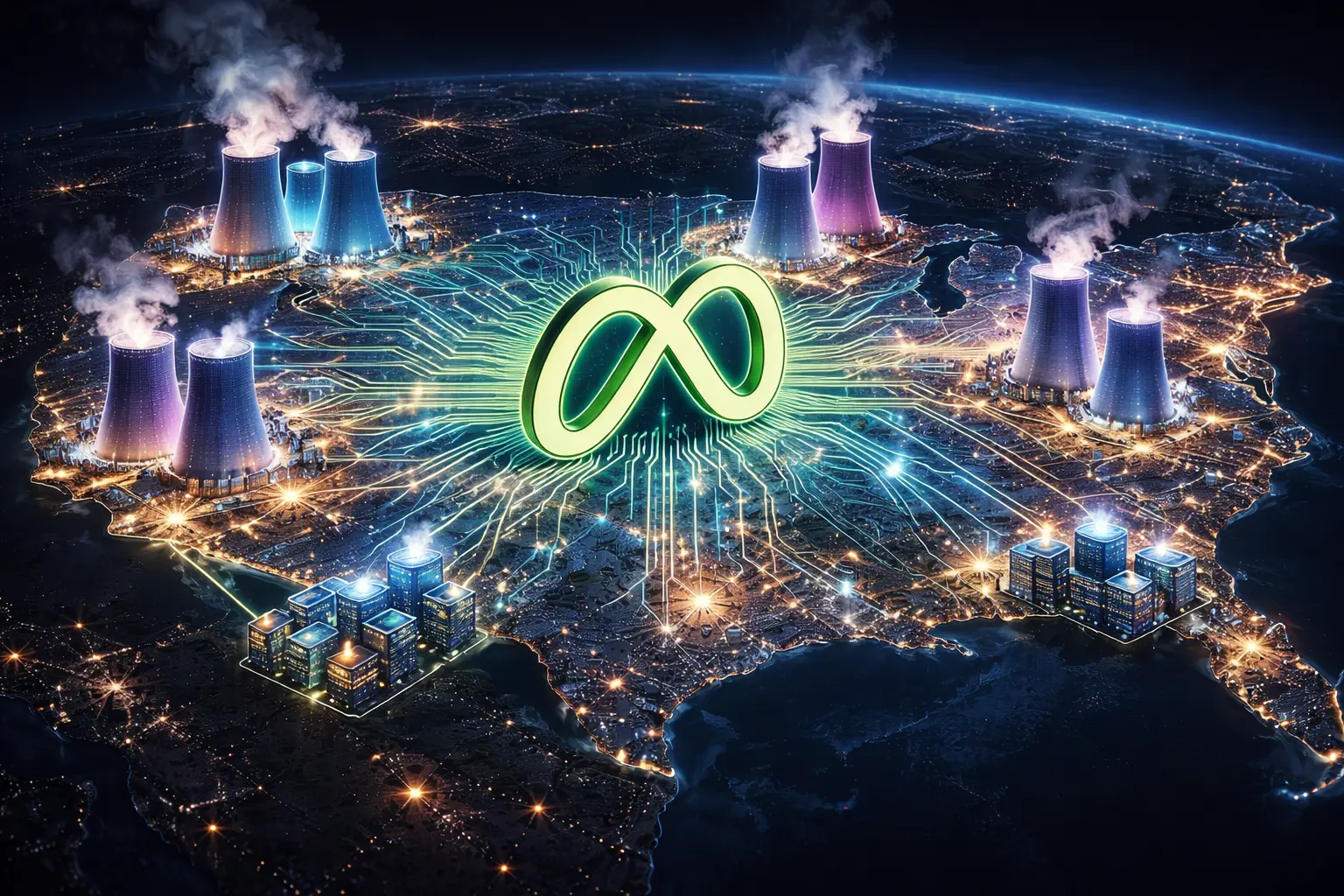
Meta has entered into 20-year contracts with energy company Vistra to purchase electricity from three nuclear plants in Ohio and Pennsylvania. In parallel, the company plans to financially back the development of so-called Small Modular Reactors (SMRs) by Oklo and TerraPower.
Together, the projects are expected to deliver up to 6.6 gigawatts of capacity by 2035—roughly equivalent to six or seven conventional nuclear power plants. Joel Kaplan, Meta’s Chief Global Affairs Officer, said that, combined with a deal signed with Constellation Energy in 2025, Meta has become “one of the most significant corporate buyers of nuclear energy in U.S. history.”
The announcement highlights the growing energy appetite of major tech companies. According to Reuters, AI applications and data centers are driving U.S. electricity demand higher for the first time in two decades.
Vistra to Keep Existing Plants Running Longer
Most of the planned capacity will come from existing facilities. Meta plans to source more than 2.1 gigawatts from Vistra’s Perry and Davis-Besse plants in Ohio. All three sites—including Beaver Valley in Pennsylvania—are also set to be expanded. These so-called uprates would add a combined 433 megawatts of capacity and are expected to come online in the early 2030s.
Meta described the initiative as the largest nuclear plant expansion in the U.S. ever supported by a corporate customer. The agreements are also intended to extend the operating life of the plants, which are currently licensed to run until at least 2036.
New Reactor Technologies Target the 2030s
More ambitious—and more uncertain—are Meta’s plans for next-generation reactors. With TerraPower, a company backed by Bill Gates, Meta has agreed to support the development of two sodium-cooled reactors with a combined capacity of up to 690 megawatts, potentially starting as early as 2032. Meta has also secured rights to up to six additional units totaling 2.1 gigawatts by 2035.
In total, the TerraPower partnership could involve up to eight reactors providing 2.8 gigawatts of baseload power, plus 1.2 gigawatts of integrated energy storage. Meta calls this its largest commitment to advanced nuclear technologies to date.
The partnership with Oklo focuses on a new nuclear energy campus in Pike County, Ohio, which could deliver up to 1.2 gigawatts of clean power, possibly beginning around 2030.
Small Modular Reactors Still Largely Unproven
Market enthusiasm should be tempered by the fact that SMRs remain largely theoretical. There are currently no commercially operating SMRs in the United States, and both projects still require regulatory approval.
Supporters argue that SMRs can be built in factories rather than on site, potentially reducing costs and construction times. Critics, however, question whether smaller reactors can ever achieve the economies of scale of large nuclear plants.
Jobs and Regional Impact
Meta emphasized the economic benefits of the projects, promising thousands of construction jobs and hundreds of long-term operational roles, along with new tax revenues for local and state governments.
The company already operates the Prometheus supercluster in New Albany, Ohio. The nuclear plants will feed power into the PJM grid, which also supplies Meta’s data centers. Meta said it will fully cover the energy costs of its data center operations.
Last year, Meta also signed a deal with Constellation Energy to keep a nuclear power plant in Illinois running for an additional 20 years.
Outlook: If approved and delivered on schedule, Meta’s nuclear strategy could set a template for how big tech secures long-term, low-carbon power for AI at scale. However, delays or cost overruns in advanced reactor projects would likely test investor patience and slow broader adoption of next-generation nuclear energy.
 ES
ES  EN
EN