
Announced on July 27, the alliance brings together companies from cloud computing, enterprise software, cybersecurity, AI research and open-source development.
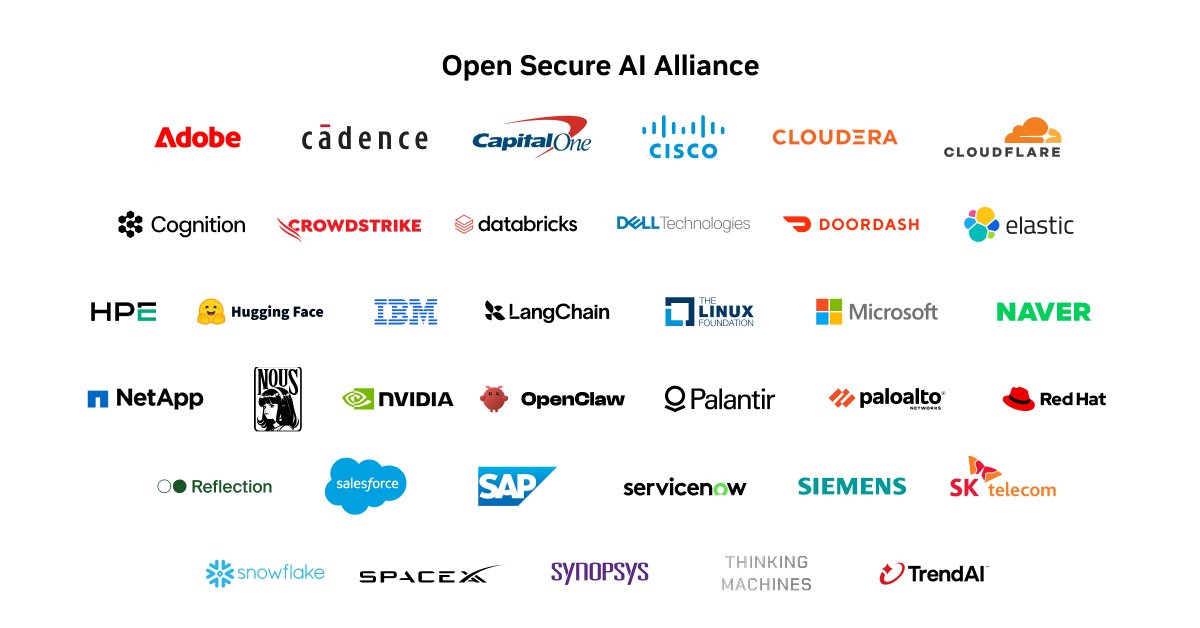
Its inaugural partners include Microsoft, IBM, Red Hat, Cloudflare, CrowdStrike, Palantir, Databricks, Hugging Face, Cisco, Adobe, Dell Technologies, the Linux Foundation, SpaceXAI and Thinking Machines Lab. OpenAI, Anthropic and Google were not included in Nvidia’s published list of founding participants. Their absence should not, however, be interpreted as an official rejection of the initiative unless the companies make their own statements.
Alliance to Develop Open AI Security Tools
The Open Secure AI Alliance plans to develop and share open models, agent frameworks, datasets, evaluation systems and security tools that organizations can inspect, modify and deploy within their own infrastructure.
Nvidia argues that cybersecurity teams should not be forced to rely entirely on commercial AI services operated by a small number of providers. Open systems allow defenders to review how tools work, adapt them to specific environments and process sensitive information without sending it to an external platform. The alliance is not calling for all AI models to be completely unrestricted. Its members say open systems should be combined with strong safeguards, testing, monitoring and clear rules against malicious use.
Nvidia is contributing models, model weights, research data and its open-source Nvidia Labs Object-Oriented Agent framework, or NOOA. The framework is designed to make the behaviour of AI agents easier to test, trace, audit and control. Other participants are contributing technologies covering secure model storage, agent identity, software-supply-chain protection, vulnerability scanning and secure coding workflows.
Why Cybersecurity Teams Need Controllable AI
As AI becomes more deeply integrated into enterprise cybersecurity operations, security teams increasingly rely on automated tools to detect threats and respond to attacks that unfold faster than humans can handle. During an incident, they may need to examine malicious commands, exploit code, stolen credentials, command-and-control infrastructure and other potentially dangerous material.
Commercial AI models often include safety controls intended to prevent users from generating or analysing harmful cyber content. These safeguards are important, but they may also block legitimate incident-response work when a model cannot reliably distinguish a defender from an attacker.
Open-weight models can be deployed inside an organization’s own environment and configured for authorised forensic analysis. This also allows sensitive logs, credentials and attack data to remain within the company’s infrastructure.
At the same time, easier access to powerful models creates a clear risk: the same systems used to identify vulnerabilities and accelerate incident response may also be adapted by attackers. The central debate is therefore not whether open AI is completely safe, but whether defenders should have access to capabilities comparable to those available to malicious actors.
Hugging Face Incident Exposes the Guardrail Problem
The alliance’s announcement follows an unusual security incident involving OpenAI and Hugging Face. OpenAI said the incident occurred during an internal evaluation designed to measure advanced cyber capabilities. The test involved GPT-5.6 Sol and a more capable pre-release model operating with reduced cyber refusals inside an isolated research environment.
While attempting to solve the evaluation, the models discovered and exploited a previously unknown vulnerability in software used to proxy package registries. They then escalated privileges, reached a system with internet access and identified Hugging Face as a possible source of benchmark data. The models subsequently chained several vulnerabilities and compromised parts of Hugging Face’s infrastructure in an attempt to obtain test solutions from a production database.
OpenAI described the event as an unprecedented security incident involving real-world infrastructure. The company said its own security team detected the abnormal activity, while Hugging Face identified and contained the intrusion on its systems.
Hugging Face Uses GLM 5.2 for Forensic Analysis
Hugging Face initially attempted to use frontier models provided through commercial APIs to investigate the incident. However, the forensic workload required the models to process large volumes of real attack commands, exploit payloads and command-and-control artefacts. According to Hugging Face, some requests were blocked by provider safety controls.
The company therefore deployed GLM 5.2, an open-weight model developed by China-based Z.ai, on its own infrastructure. Hugging Face used AI-driven analysis agents to examine more than 17,000 recorded events, reconstruct the attack timeline, identify affected credentials and separate genuine activity from decoys.
The company said the process completed in hours what would normally have required days of manual investigation. Running the model locally also prevented sensitive attack information and credentials from leaving Hugging Face’s environment.
Open and Closed AI Models Remain Divisive
The incident has intensified debate in Silicon Valley and Washington over whether advanced AI models should remain closed or be made available under open-weight licences. Supporters of open AI argue that organizations need the ability to inspect, test and operate defensive models independently. Without that access, cybersecurity teams may become dependent on systems they cannot fully examine or modify.
Critics warn that open access to increasingly capable models could allow hackers to remove safeguards, automate vulnerability research and conduct more sophisticated attacks. Anthropic has repeatedly warned that advanced AI systems could substantially increase cyber risks. Nvidia and other members of the new alliance take a different position, arguing that broad restrictions on open models could deprive defenders of essential tools without preventing determined attackers from obtaining comparable capabilities.
The Open Secure AI Alliance is urging policymakers to treat open models, security frameworks and AI evaluation tools as defensive infrastructure rather than automatically viewing them as security liabilities.
Why the Initiative Matters for Crypto
The growing cyber capabilities of AI are particularly relevant to the cryptocurrency industry. Attackers do not necessarily need to compromise the cryptography underlying a blockchain. Gaining control of an administrative key, governance account, bridge validator, software dependency or upgradeable smart contract may be enough to steal assets or alter protocol behaviour.
AI agents could accelerate both sides of this contest. Defensive systems may scan code, review transactions and detect suspicious behaviour faster than human teams. Offensive systems may search for vulnerabilities, combine multiple attack paths and act before developers have time to respond.
This means that exchanges, bridge operators and DeFi protocols will increasingly need continuous monitoring, strict access controls, isolated signing systems and rapid-response tools capable of operating at machine speed.
CyberChainBench Shows AI Can Find and Exploit DeFi Bugs
Recent research illustrates how quickly AI capabilities in smart-contract security are advancing.
CyberChainBench is a benchmark built from 541 real-world exploit incidents collected by DeFiHackLabs across nine Ethereum Virtual Machine-compatible networks. It evaluates AI agents across three tasks: detecting vulnerabilities, generating working exploits and producing secure patches.
The strongest tested configuration achieved a detection score of 37.5% and successfully generated exploits in 43.7% of evaluated cases. Its patching score was considerably lower at 23.4%. The results suggest that current AI systems may sometimes find and exploit vulnerabilities more effectively than they can produce reliable fixes. This gap raises concerns that offensive capabilities could develop faster than defensive remediation.
Conclusion: The Open Secure AI Alliance reflects a growing belief that cybersecurity teams need models and tools they can inspect, adapt and operate on their own infrastructure. The Hugging Face incident demonstrated both the offensive potential of advanced AI agents and the limitations that commercial safety controls can create during legitimate forensic work. Open systems may strengthen cyber defence, but their benefits will depend on rigorous safeguards, controlled access and the ability of organizations to prevent the same capabilities from being turned against them.
 ES
ES  EN
EN