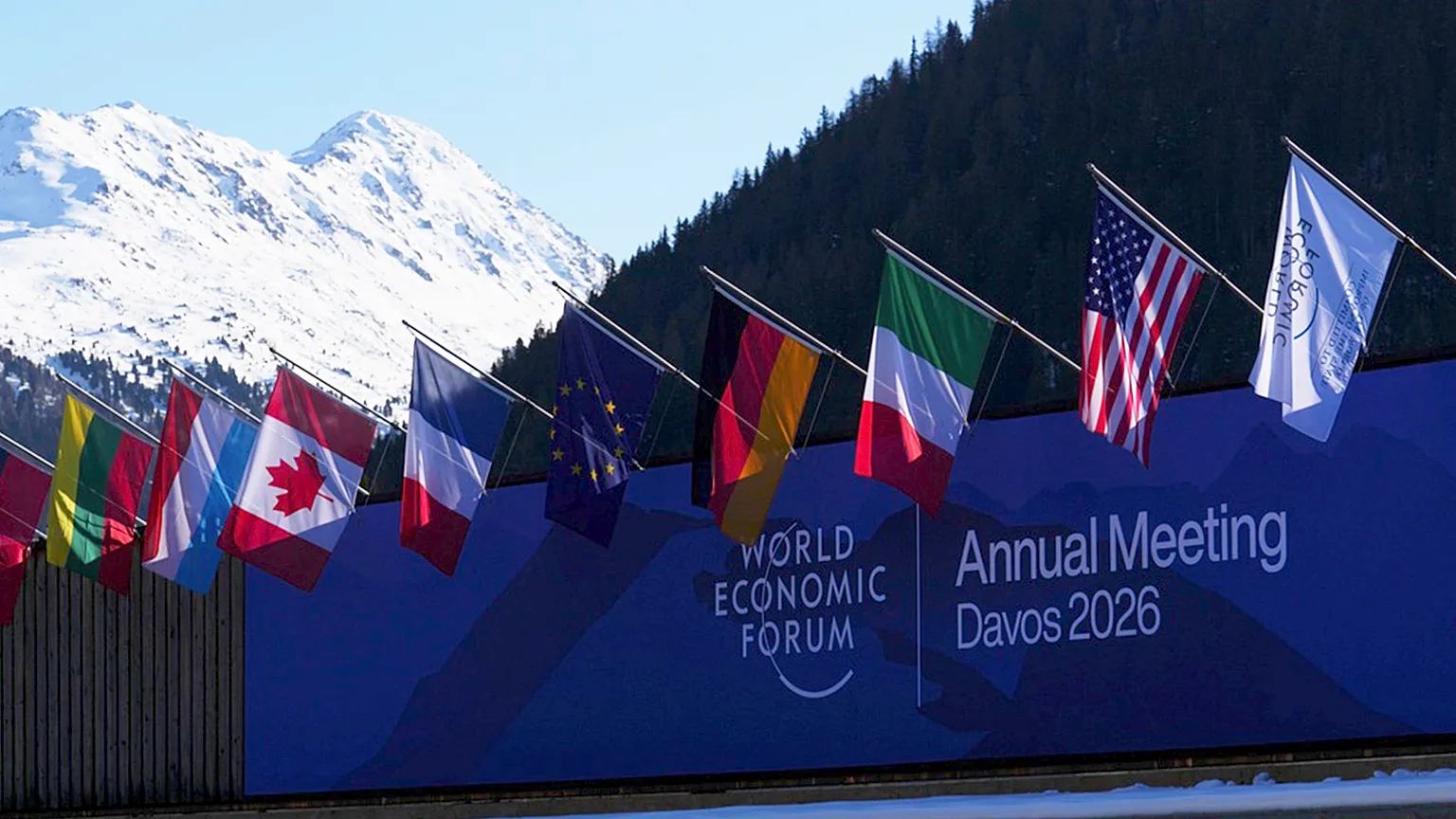

The World Economic Forum in Davos put the spotlight on global development prospects amid persistent economic uncertainty, accelerating technological change, and intensifying geo-economic fragmentation.
Davos 2026 focused on finding a balance between the resilience of the world economy and mounting political, financial, and structural risks, as well as the role of innovation and artificial intelligence in shaping new sources of growth.
Updated estimates cited in local reporting point to global growth of about 3.3% this year, easing to 3.2% in 2027. Those numbers broadly match 2025 and suggest neither a global recession nor a rapid rebound. More conservative projections from the World Bank put this year’s global growth at around 2.6%, while the OECD expects about 2.9%—a spread that underscores elevated uncertainty, especially around trade and industrial policy in major economies. The divergence in forecasts itself signals unstable expectations and the global economy’s sensitivity to external shocks.
One of the defining trends of the year remains disinflation and the gradual easing of monetary policy in parts of the developed world. Softer inflation pressure creates room for rate cuts, supporting investment activity and financial markets. But the process is uneven. The “final stage” of the inflation fight has come with high volatility in bond and FX markets, and greater sensitivity to new shocks.
AI as a stress test
Against this backdrop, geo-economic fragmentation is becoming a stronger force. Weaker WTO mechanisms, rising protectionism, threats of new tariffs, sanctions regimes, and export controls continue to erode business confidence and weigh on cross-border investment. The single global economic space is increasingly splitting into competing macro-regions and supply chains shaped by political alignment and strategic security. Key corridors appear particularly vulnerable—US–China, US–EU, and routes tied to energy and maritime transport.
In this environment, global headline growth can mask stagnation in specific regions and sectors. OECD estimates referenced in the piece suggest US GDP growth near 1.7%, the euro area around 1.2%, while China remains higher at roughly 4.4%—highlighting an increasingly uneven global picture.
AI featured prominently at Davos 2026 as both a growth driver and a source of new structural risks. Investment in AI, digital infrastructure, and automation is becoming a major engine of capex for advanced economies and large corporates. In theory, AI can lift productivity, offset demographic pressure, and accelerate modernization across industries—from finance and logistics to manufacturing and healthcare. This dynamic helps explain why global growth has remained relatively resilient despite political turbulence.
But AI’s impact is asymmetric. Capital and benefits concentrate in a limited set of countries, companies, and sectors—widening inequality both between and within nations. Outside tech-leading economies and firms, low productivity persists, while rapid expansion in AI can raise overheating risks, fuel asset bubbles, and amplify social tensions as labor markets adjust. In that sense, AI acts as a stabilizer for growth while also creating longer-term structural imbalances.
Another constraint is elevated public debt and fiscal pressure. Higher debt-service costs reduce governments’ ability to use budget stimulus, making economies more exposed to external shocks. Under these conditions, even moderate disruptions—from trade disputes to regional crises—can have outsized effects.
Moderate growth, cautious optimism
Despite fragmentation, Davos remains one of the few venues that still enables multilateral dialogue. The overall conclusion is a phase of moderate growth with asymmetric risks: acceleration is possible if AI-driven investment diffuses more widely, while a slowdown scenario is tied to renewed trade escalation, geopolitical instability, and limited fiscal space.




 ES
ES  EN
EN