

Vitalik Buterin has outlined a possible path toward integrating Ethereum with artificial intelligence, emphasizing the need to pursue a positive trajectory that puts human freedom and safety first.
He envisions an AI future in which:
-
human freedom and empowerment are preserved. Two scenarios are explicitly rejected: one where everyone is “pensioned off” because of AI, and another where pro-government structures permanently strip the masses of power;
-
the world does not explode—neither through a “classic apocalypse” caused by superintelligent AI, nor through more chaotic failure scenarios.
“In the long term, this could include things that may sound crazy at first, like digitizing human consciousness or merging with AI. These ideas concern those who want to keep up with extremely intelligent entities capable of thinking millions of times faster on silicon,” Buterin noted.
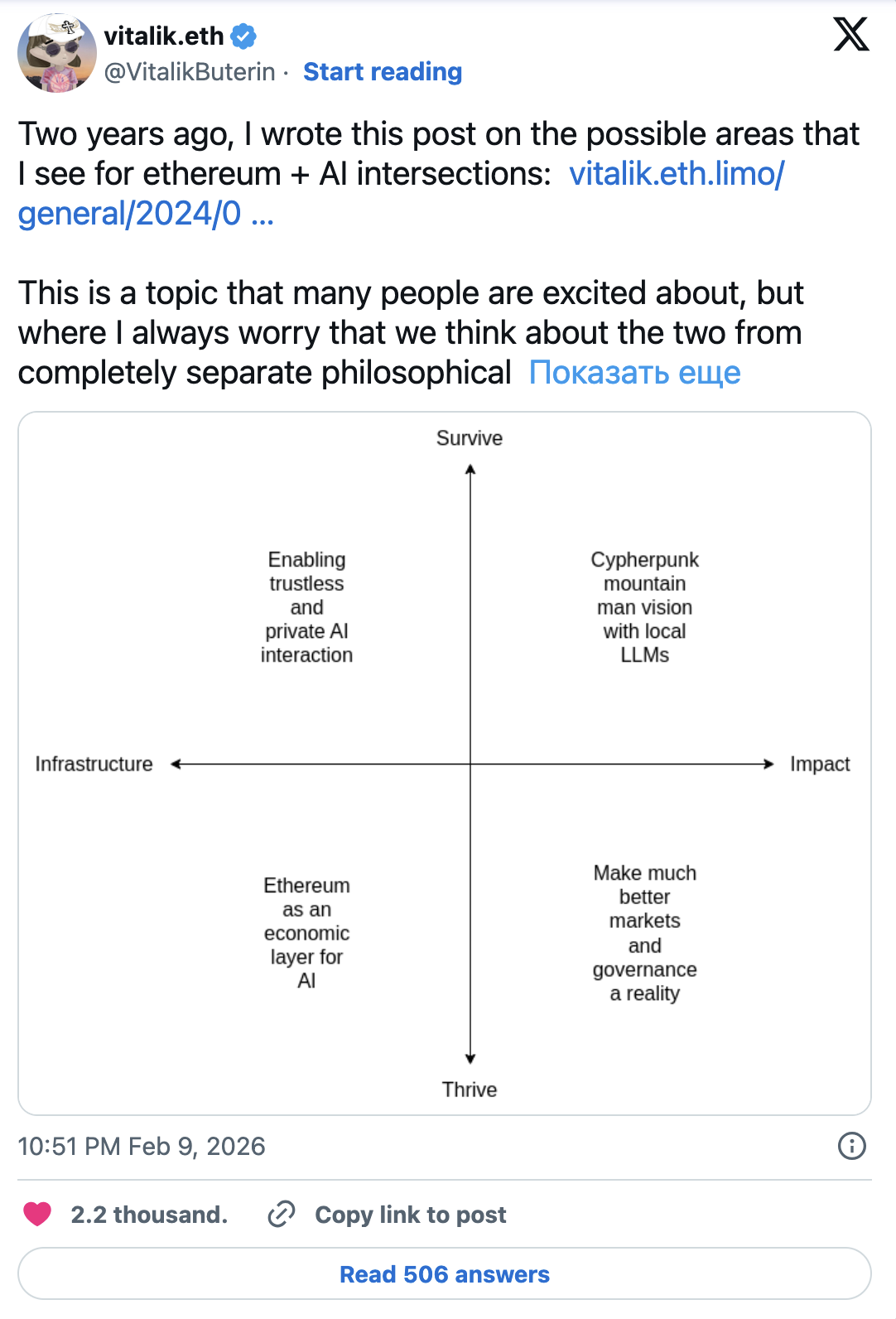
In the near term, the focus is on more “familiar” ideas, though they still require a deep rethinking compared with previous computational paradigms. Buterin identified four areas where he sees joint development with Ethereum.
Tools for private interaction with AI
Buterin argues that new ways must be developed to interact with AI in a trust-minimized manner. These include:
-
local tools for large language models (LLMs);
-
zero-knowledge payments for API calls, enabling access to remote models without revealing one’s identity from request to request;
-
cryptographic approaches to enhancing AI privacy;
-
client-side verification of cryptographic proofs, TEE attestations, and other forms of server-side guarantees.
“These are the same kinds of things we could also build for non-LLM computation,” he said.
Ethereum as the economic layer for AI interactions
In this category, Buterin includes:
-
API calls;
-
bots that hire other bots;
-
insurance deposits, and over time more complex mechanisms such as on-chain dispute resolution;
-
ERC-8004 and AI reputation concepts.
The goal is to give neural networks tools for economic interaction, making decentralized AI architectures viable.
Implementing the cypherpunk vision of the “mountain hermit”
This concept envisions an environment where everything is verifiable. Today, it is impractical because humans cannot physically analyze all the code involved. With LLMs, the idea becomes feasible.
Buterin includes in this category:
-
interacting with Ethereum-based applications without relying on third-party interfaces;
-
a local model that proposes transactions on its own;
-
another model that verifies operations generated by decentralized application interfaces;
-
smart contract audits and assistance in interpreting the meaning of fraud-proof (FV) evidence;
-
verification of trust models for applications and protocols.
Building more effective markets and governance
Prediction markets, decentralized governance, quadratic voting, combinatorial auctions, universal barter economies, and similar constructs sound compelling in theory, but in practice are heavily constrained by a major limitation: the limits of human attention and decision-making capacity, Buterin argues.
LLMs remove this constraint by massively scaling human judgment, allowing people to revisit and rethink these ideas.
“All of these are things that Ethereum can help make real. They also align with the spirit of d/acc: strengthening decentralized cooperation and improving defense. We can return to the best ideas of 2014, add many new and more advanced ones, and with AI and zero-knowledge proofs we now have an entirely different set of tools to bring them to life,” Buterin concluded.





 ES
ES  EN
EN