

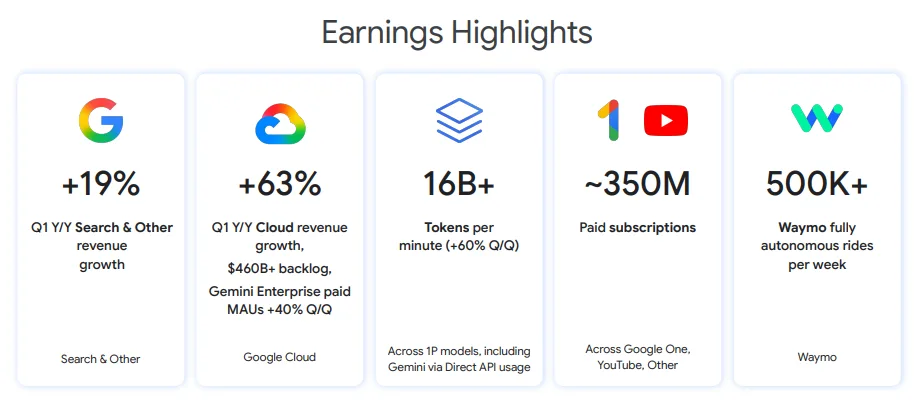
Rapid growth in server and network services is driving this massive capital demand: Google Cloud surpassed $20 billion in quarterly revenue for the first time, representing 63% year-over-year growth. Google attributes this growth primarily to AI demand, pointing to a sharp increase in token consumption as a key indicator.
Cloud revenue could have been even higher: CEO Sundar Pichai said the company was temporarily constrained by a lack of compute capacity. The cloud order backlog grew to $462 billion.
Overall, Alphabet posted record Q1 2026 revenue of $109.9 billion — up 22% year-over-year. Google will also begin selling its TPU chips (proprietary AI accelerators) not just as cloud infrastructure, but delivering them directly to the data centers of select enterprise customers.
Strong Growth, But No Concrete AI Revenue Figures
Revenue from generative AI models reportedly surged 800% year-over-year, with deal sizes increasing. The number of paying monthly active users on Gemini Enterprise — Google's B2B offering — grew 40% in a single quarter. Consumer-facing Gemini products also experienced their strongest quarter to date.
The supposedly dying Google Search grew 19% to $60.4 billion. Advertising chief Philipp Schindler credited Gemini's improved ability to understand user intent behind search queries — enabling Google to serve relevant ads even for longer and more complex searches, something that was previously difficult to achieve.
"People love our AI experiences like AI Mode and AI Overviews and are coming back to Search more often," said CEO Pichai. AI-generated answers have drawn criticism, however, as Google intercepts traffic that would otherwise reach external websites — inserting itself into other publishers' revenue streams with minimal additional cost.
Ads within the Gemini chatbot are planned for the future, though the current focus remains on AI Mode. The cost of serving AI Overviews and core AI responses in AI Mode has fallen 30% through advances in hardware and engineering.
That said, Google still does not disclose specific revenue figures for its AI business. It also remains unclear how much of the booked workload stems from circular deals with AI startups such as Anthropic — companies that receive investment from Google and then spend it back on Google's infrastructure. Equally open is the question of what real economic value enterprises are actually extracting from their AI workloads — which may ultimately determine whether Google and other hyperscalers can justify their massive investments over the long term.
 ES
ES  EN
EN