
According to CEO Sam Altman, GPT-5.6 delivers a major leap in processing efficiency. Sol, in particular, uses approximately 54% fewer tokens for AI coding tasks than the previous generation, significantly reducing operating costs while maintaining output quality.
Tokens are the basic units of data processed by AI models. Input tokens include text, source code or other data submitted by users, while output tokens refer to the content generated by the AI in response. Model usage costs are generally calculated based on the combined number of input and output tokens.
ChatGPT Work is presented as an “AI colleague” for office employees. Work is designed as an AI agent capable of handling complete workflows, including research, data analysis, report writing, spreadsheets, presentations, website development and the coordination of multiple long-running tasks within a single project.
ChatGPT Work can also connect directly to systems such as Slack, Gmail, Google Drive and customer relationship management platforms to retrieve business data and automatically complete a wide range of office tasks.
The names chosen for the three new models have attracted considerable attention within the crypto community. Sol, Terra and Luna happen to coincide with the names or ticker symbols of well-known blockchain projects, including Solana, or SOL, and the Terra and LUNA ecosystem that collapsed in 2022.
However, OpenAI has not announced any plans related to blockchain or digital assets, and there are no indications that these names were intended to suggest a connection with crypto.
The cryptocurrency market also showed almost no reaction to the coincidence. SOL moved by only around 1.5%, broadly in line with the wider market, while LUNA recorded no significant price movement following OpenAI’s announcement.
The Battle With Anthropic Enters a New Phase
The most notable feature of GPT-5.6 is its focus on cybersecurity. OpenAI describes it as the most powerful security model the company has ever developed, with the ability to support attack simulations, review source code, detect vulnerabilities and recommend patches, while still restricting unauthorized cyberattack activity.
These capabilities reportedly prompted the administration of US President Donald Trump to ask OpenAI to delay the broad release of GPT-5.6 for several weeks while national security risks were assessed. Only after the review process was completed was the company allowed to gradually expand deployment to users worldwide.
In addition to cybersecurity, OpenAI is also directly targeting its largest current competitor, Anthropic.
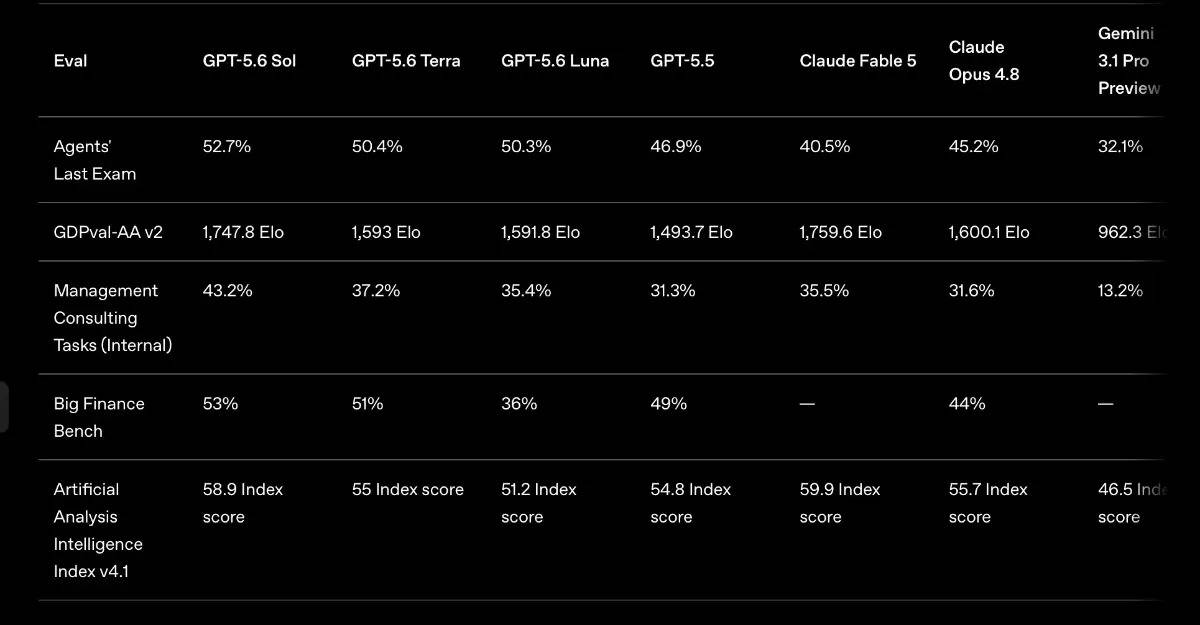
Citing data from the Artificial Analysis Coding Agent Index, OpenAI said Sol scored 80 points, outperforming Anthropic’s Claude Fable 5 by 2.8 points while using less than half as many tokens, taking less than half the processing time and costing approximately one-third less.
The company also claimed that Terra slightly outperforms Fable 5, while Luna surpasses Claude Opus 4.8 in the lower-cost segment.
GPT-5.6 is now available through ChatGPT, Codex and the OpenAI API. API pricing remains relatively competitive. Sol costs $5 per million input tokens and $30 per million output tokens. Terra is priced at $2.50 and $15, respectively, while Luna costs just $1 per million input tokens and $6 per million output tokens.
The AI race is intensifying by the day. One day before GPT-5.6 was released, SpaceXAI, formerly known as Elon Musk’s xAI, launched Grok 4.5 with several improvements.
The new model focuses on programming and automation tasks, although it is still considered to be lagging behind its competitors.
For the crypto market, AI is gradually becoming a new variable in the industry. There is no doubt that the technology enables developers to write code, audit smart contracts, analyze blockchain data and detect vulnerabilities much more quickly.
However, the same capabilities are also being used by hackers to identify weaknesses, trace identities and automate attacks on a larger scale.
In practice, AI has already demonstrated both sides of this issue. Vitalik Buterin recently revealed that an AI model was able to identify him as the author of an anonymous Ethereum proposal by analyzing his reasoning style.
conclusion: GPT-5.6 shows that the AI race is increasingly shifting toward efficiency, autonomous workflows and cybersecurity. For the crypto industry, stronger AI tools could improve smart contract development and vulnerability detection, while also increasing the sophistication of automated cyberattacks.
 ES
ES  EN
EN