

What’s known
The company notes that additional privacy safeguards apply in this mode. Conversations conducted within ChatGPT Health are not used to train language models. The feature is currently in a testing phase, and the list of supported applications may vary by region.
OpenAI also emphasizes that the tool is not intended for medical diagnosis or treatment. All responses provided by ChatGPT Health should be treated strictly as informational reference material.
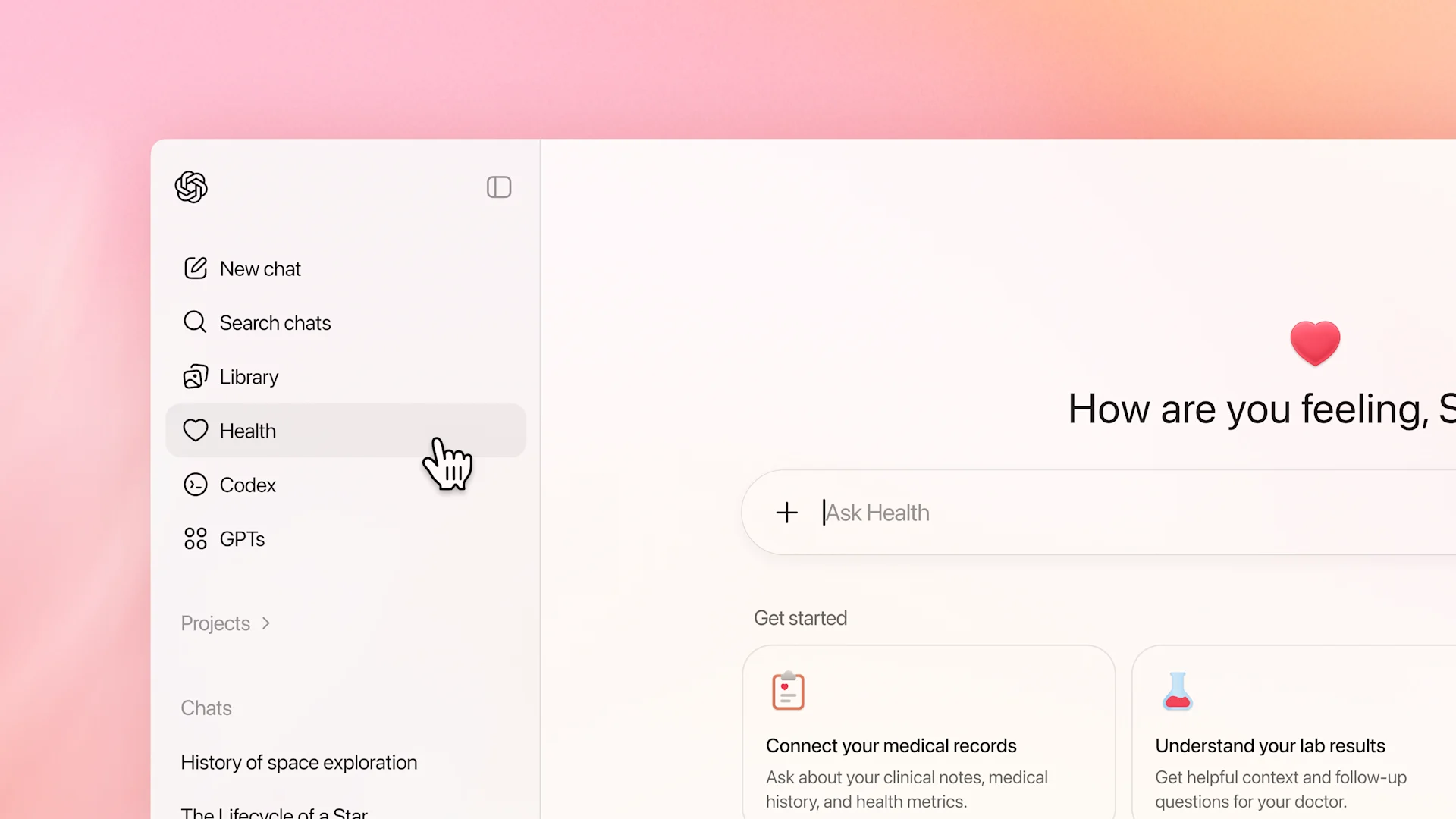
Interaction still takes place in a familiar chat interface, but the model can take connected health data into account. Users can ask questions such as “How is my cholesterol changing?” or “Summarize my latest test results,” upload files and images, and use voice mode. The section also allows custom instructions—for example, prioritizing specific topics or excluding unwanted ones.
ChatGPT Health does not provide diagnoses or prescribe treatment. Its role is to help users interpret information, analyze metrics from apps like Apple Health or MyFitnessPal, and prepare for consultations with medical professionals.
To enable access to the most sensitive data, including electronic health records, OpenAI partnered with b.well, a platform compliant with HIPAA industry standards. All integrations require explicit user consent, which can be withdrawn at any time.
Development of ChatGPT Health involved close collaboration with the medical community. More than 260 doctors from 60 countries contributed to its design and evaluation over a two-year period.
For quality assurance, OpenAI introduced HealthBench, an evaluation system that assesses AI responses not by abstract accuracy, but by clinical criteria—such as safety, clarity, appropriateness of recommending professional care, and proper consideration of context.
Access to ChatGPT Health will roll out to all web and iOS users in the coming weeks. At the time of writing, the service is available in a limited test phase for a select group of users in the United States.
ChatGPT Health interface by OpenAI
The launch comes amid growing interest in AI applications in healthcare, as well as ongoing discussions about the volume of personal data users share with chatbots.
 ES
ES  EN
EN