

Previously, the chatbot could retrieve information from Google services, but it can now analyze that data to provide proactive assistance. For example, the AI can link emails with videos a user has watched.
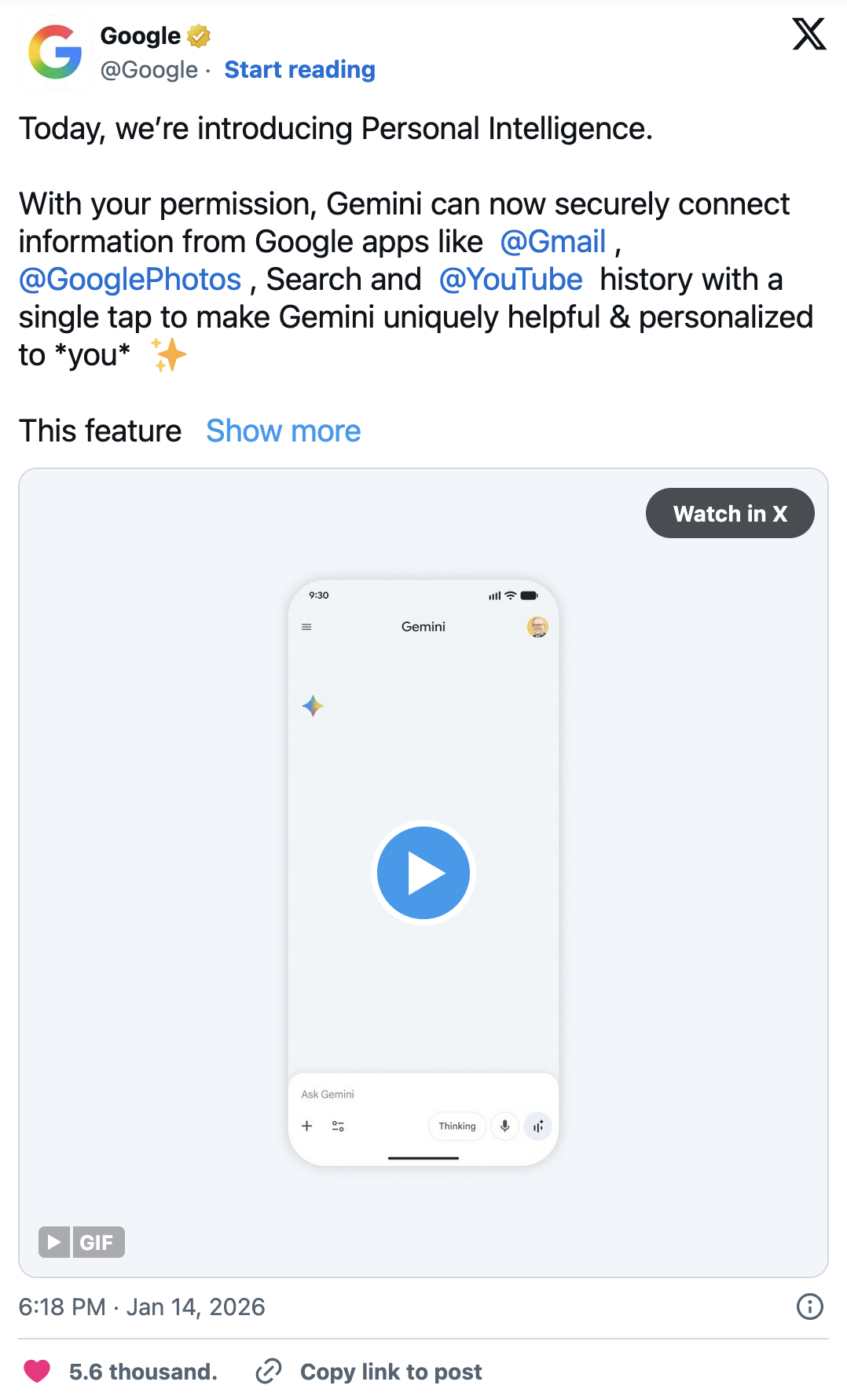
Google says Gemini understands context automatically and does not require users to specify which app it should search to find an answer. Personal Intelligence is disabled by default and must be activated manually. Even after activation, the algorithm will access personal data only when it determines that doing so is necessary to complete a task.
“Personal Intelligence has two main benefits: reasoning across complex sources and retrieving specific details — for example, from an email or a photo — to answer a question,” wrote Josh Woodward, Vice President of the Gemini app, Google Labs, and AI Studio.
He shared an example in which he was standing in line at a tire shop and couldn’t remember the correct tire size for his car. Gemini recommended an all-season option after finding and analyzing photos from a family trip in Google Photos. The chatbot also identified the vehicle’s license plate number.
“I get great recommendations for books, shows, clothing, and travel,” Woodward wrote.
By analyzing data from Photos and Gmail, the system took into account family interests and past travel history. As a result, the AI built a travel itinerary that avoided “tourist traps,” suggesting an overnight train journey and board games for the trip.
Gemini has restrictions on sensitive topics. The chatbot will not proactively give health advice but is willing to discuss health-related topics if the user explicitly asks.
Google also emphasizes that the model is not trained on personal data. Instead, it uses individual queries and responses to generate answers.
Personal Intelligence is currently available to subscribers of Google AI Pro and AI Ultra plans in the United States. The company plans to expand availability to other regions and eventually introduce the feature to the free tier.
Google Trends with AI
Google has also updated the Trends Explore page by integrating Gemini. The AI now automatically identifies and compares search trends.
Popular among journalists and researchers, the service helps track interest in topics across regions and analyze how trends evolve over time.
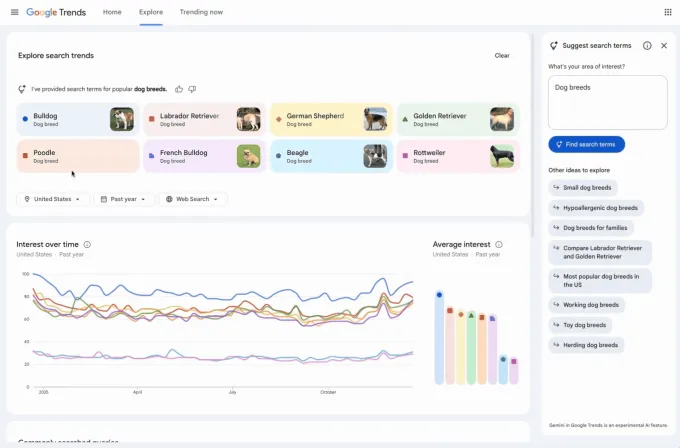
The new interface automates routine tasks: an AI-powered side panel independently compares current trends within a selected niche and suggests directions for deeper analysis.
In the redesigned page, each query is highlighted with a unique color and icon. Google has also increased the number of elements that can be compared simultaneously.
Conclusion:
Google’s rollout of Personal Intelligence underscores a broader shift toward deeply contextual AI assistants that operate across personal data ecosystems. If implemented transparently and with strict safeguards, this approach could redefine how users interact with AI—moving from reactive answers to genuinely anticipatory, trust-based assistance.
 ES
ES  EN
EN