

The developers said the new product addresses users’ main pain point—the need to switch between multiple services. Analytics and trading are now combined in a single interface.
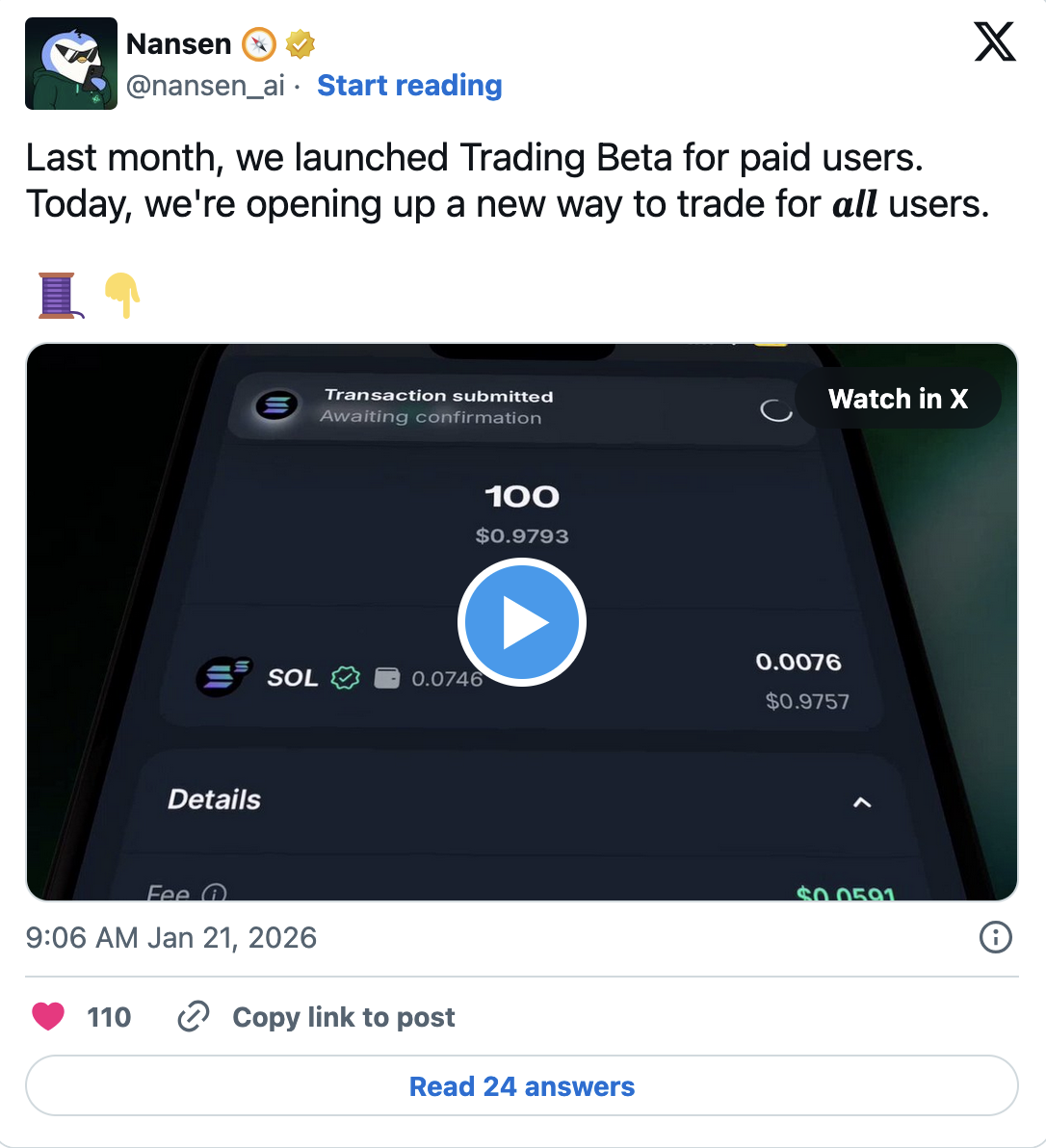
“This is the most significant product in Nansen’s history. For years, we’ve been the best in the world at delivering high-quality signals. Our analytics foundation made Nansen AI and our mobile app possible. Now we’re closing the loop by enabling users to trade directly within our product—through an AI interface in the mobile app and a trading terminal on the web,” commented co-founder and CEO Alex Svanevik.
How does the AI agent work?
The tool implements the concept of “vibe trading,” allowing users to manage their portfolios via a regular chat interface in the browser or mobile app.
The system generates recommendations based on data analysis, but every trade requires user confirmation. The AI agent operates under predefined algorithms and does not control user funds.
For swaps on Solana, the service uses the Jupiter liquidity aggregator; on Base, it uses OKX DEX. LI.FI provides cross-chain routing. All transactions go through the built-in Nansen Wallet, which relies on Privy infrastructure for non-custodial accounts.
The service is unavailable in certain jurisdictions, including Singapore, Cuba, Iran, North Korea, Syria, and Russia.
Nansen is making a clear and timely move. By combining on-chain analytics and trading in a single interface, the platform shifts from being a data provider to a tool for direct action. This reduces friction and lowers the entry barrier, especially for users who previously had to jump between multiple services. Importantly, execution remains user-controlled rather than fully automated by AI, which is a sensible balance. If Nansen maintains transparency and the quality of its signals, this approach could well become a new standard for on-chain trading in the near future.
 ES
ES  EN
EN