
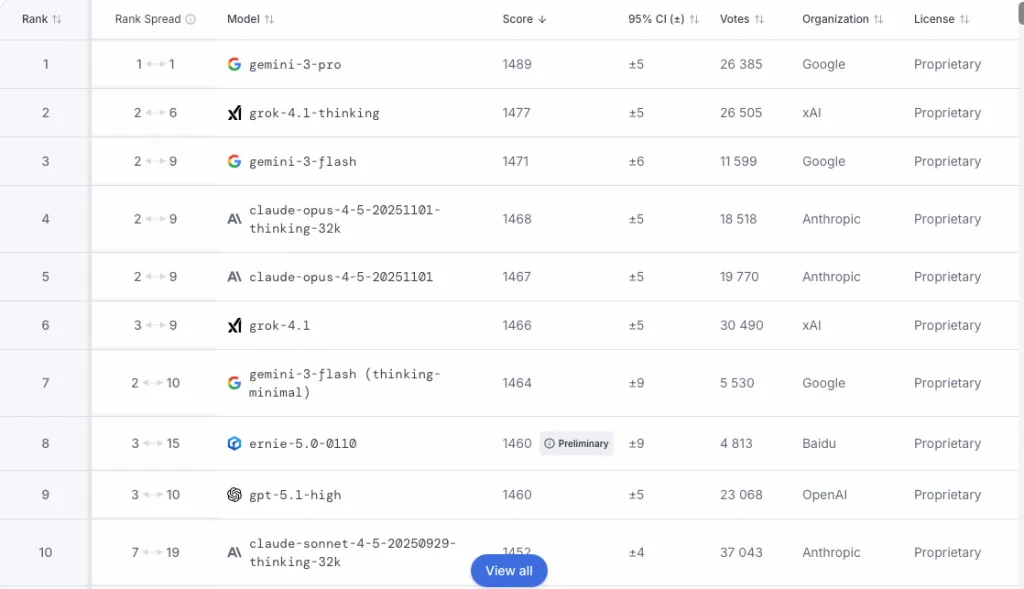
ERNIE-5.0-0110 scored 1,460 points in the LMArena Text ranking, placing eighth globally and becoming the only Chinese model in the global top 10. It outperformed OpenAI’s GPT-5.1-High and Google’s Gemini-2.5-Pro.
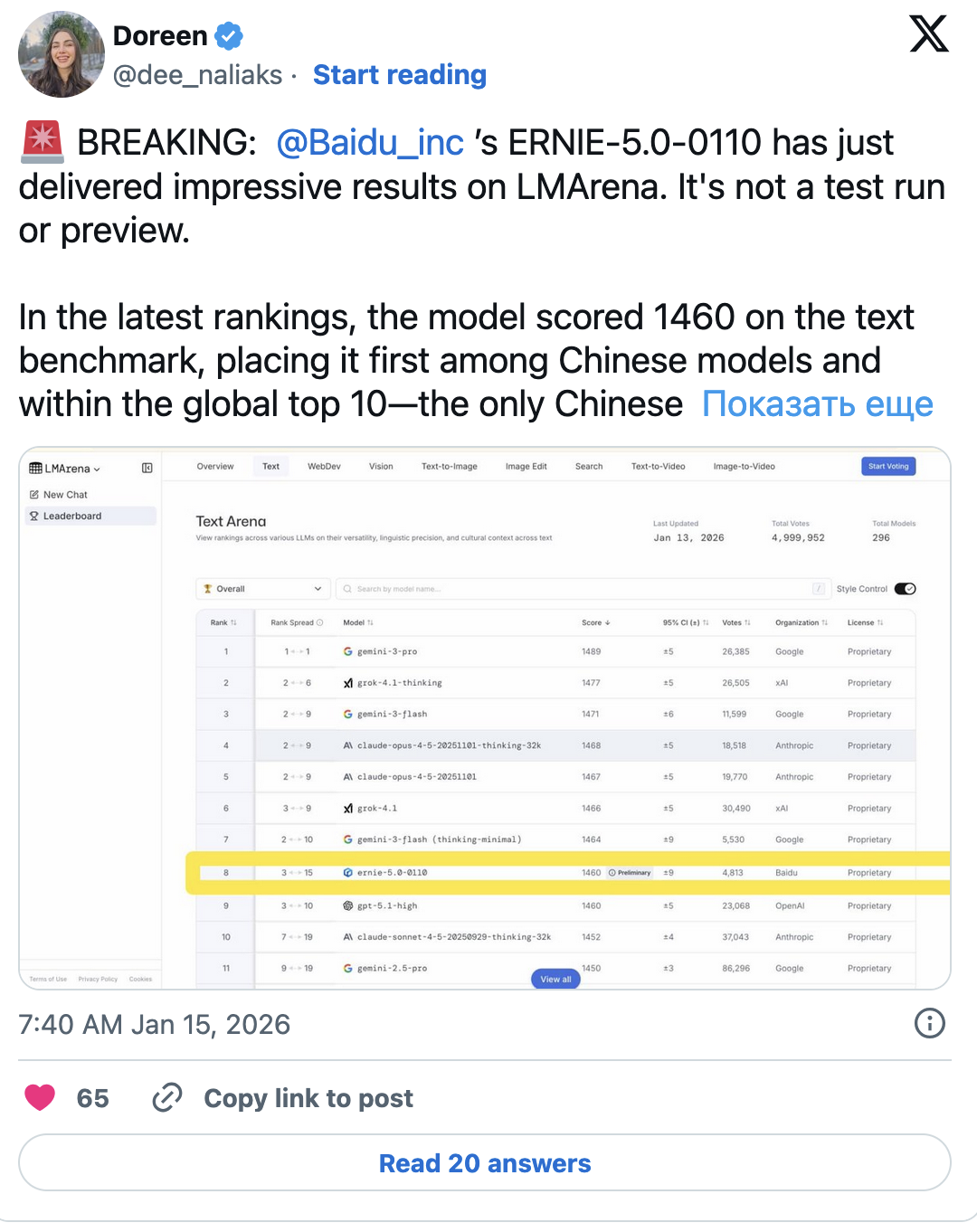
The model also ranked second in mathematical reasoning, trailing only GPT-5.2-High.
The Chinese model’s performance against most publicly available Western systems on complex reasoning tasks highlights a significant narrowing of the AI capability gap.
ERNIE-5.0-0110 also demonstrated competitive performance in creative writing, instruction following, and programming.
The underlying LLM uses a Mixture-of-Experts architecture with 2 trillion parameters, reflecting China’s emphasis on efficiency. This design reduces per-query computation compared with dense models.
Other advances in China
Beyond Baidu, other Chinese tech companies are reporting notable AI progress.
Alibaba released an updated version of its flagship AI app Qwen, integrating it more deeply into the company’s broader ecosystem, including online shopping and hotel bookings.
The release coincided with Qwen surpassing 100 million monthly active users (MAU). In November 2025, Qwen became the fastest-growing AI application worldwide, with MAU increasing by 149%.
The solution now coordinates Alibaba’s ecosystem, allowing users to complete tasks ranging from e-commerce and food delivery to ride-hailing, reservations, and movie ticket purchases — all via voice commands.
Meanwhile, in December, Chinese generative AI service Kling AI reported more than $20 million in sales, driven by continuous product improvements.
Kling AI is China’s counterpart to OpenAI’s Sora, generating realistic videos from text prompts or images.
China closing the gap
Chinese AI models are only “a few months” behind the U.S., according to Google DeepMind CEO Demis Hassabis.
His assessment contradicts the view that China remains far behind, arguing that the country is closer to U.S. and Western AI capabilities than many believed a year or two ago.
However, Hassabis noted that Chinese companies still need to demonstrate true breakthroughs.
“The question is whether they can create something genuinely new that pushes beyond existing boundaries,” he said.
Chinese tech firms face several challenges, with access to critical technologies among the most serious. The U.S. maintains restrictions on exporting advanced Nvidia semiconductors, which are essential for training AI models.
In January, the administration of U.S. President Donald Trump officially approved the sale of Nvidia’s H200 — the company’s second-most powerful AI chip — to China. However, Chinese authorities later informed some tech firms that chip purchases would be approved only in special cases, such as university research.
Domestic manufacturers like Huawei are working to fill the gap, but their chips still lag behind Nvidia in performance.
 ES
ES  EN
EN