
Samsung first passed the $1 trillion threshold on February 26. This time, however, the stock broke through previous record levels and is on track for its largest single-day gain ever.
The rally followed a strong quarterly report. Samsung’s semiconductor division posted record first-quarter profit and came in well ahead of analyst expectations.
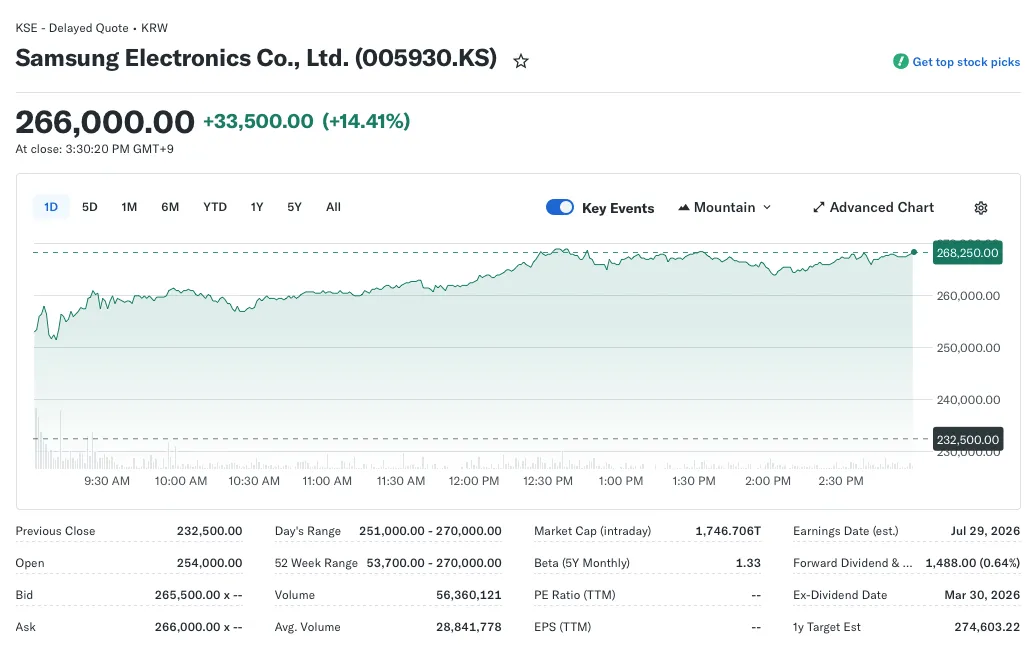
Operating profit reached 53.7 trillion won, or about $36 billion, compared with forecasts of 35.3 trillion won. The figure increased 48-fold, driven largely by strong margins on AI infrastructure and data-center hardware.
Analysts expect Samsung’s chip business to set new profit records over the next several quarters as contract prices rise amid tight supply. They point to South Korea’s semiconductor exports, which increased by more than 180% in the first 20 days of April, as further evidence of the trend.
Samsung’s stock received an additional boost from a Bloomberg report that Apple has held preliminary talks with Samsung and Intel about producing chips for its devices in the United States. A potential deal would allow the iPhone maker to diversify its supply chain beyond TSMC.
Shares of South Korean memory-chip maker SK Hynix also rose by more than 10%. The Kospi index gained 6% and climbed above 7,000 points for the first time.
Memory Drives Growth
High-bandwidth memory remains one of the main drivers of Samsung’s profitability, although the company still faces intense competition from SK Hynix.
Samsung is working to close the gap in the fast-growing AI memory segment. In February, the company said it had become the first in the world to begin mass production of HBM4, its sixth-generation high-bandwidth memory chips.
The chips are expected to become a key component of Nvidia’s future Vera Rubin AI architecture, designed for demanding data-center workloads.
This article best fits the Industry section because it focuses on Samsung’s market value, semiconductor earnings, AI infrastructure demand, and the broader chip-sector rally. The core story is about the business impact of the AI hardware boom rather than a new AI model or software platform.
 ES
ES  EN
EN