

Challenging the duopoly
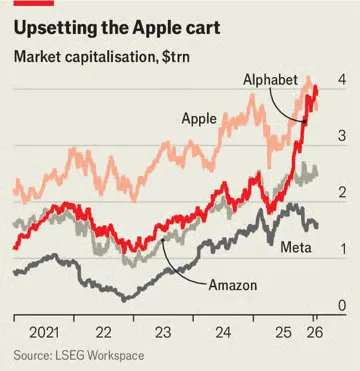
For the past two decades, Apple’s iPhone with iOS and Google’s Android ecosystem have become near-monopolies in how users interact with the digital world. Adding to this dominance, Google pays Apple substantial sums to remain the default search engine on iPhones.
In return, Apple has chosen Google’s AI solutions to enhance Siri.
“After a thorough evaluation, we concluded that Google’s technology provides the most effective foundation for Apple Foundation Models. We are excited about the innovative opportunities it will unlock for our users,” the tech giants said in a joint statement.
Neither company had much incentive to disrupt the status quo — unlike their competitors.
On January 19, OpenAI’s Head of Global Affairs, Chris Lehane, said the company is “on track” to unveil its first hardware device in the second half of 2026.
Just two days later, reports emerged that Apple is working on a wearable device designed to preempt OpenAI’s move. Meta is developing AI-powered smart glasses and is reallocating resources away from VR headsets toward this segment.
Amazon, the world’s largest online retailer, has already integrated its AI assistant Alexa+ into Echo speakers and plans to bring it soon to Echo glasses and headphones.
Rising costs
The next few years will be challenging for smartphones. Jan Stryjak of Counterpoint Research expects global shipments to fall by around 6% in 2026, with no recovery in sight, after a modest 2% growth in 2025.
One key factor behind the slowdown is the sharp rise in memory chip prices, driven by the AI boom. Massive investments in data centers have absorbed much of the global supply.
According to Stryjak, the price of 12 GB of RAM has risen by $70 over the past 15 months. Budget smartphone makers will be forced to raise prices, hurting sales volumes. Even Apple, which sells its phones at high margins, will face pressure on profitability.
The factory war
The situation is worsened by the so-called “factory war.” Smartphone makers like Apple and Samsung long dominated semiconductor orders, but they are now being overtaken by Nvidia and other AI chip developers, who are more lucrative customers for manufacturers.
As their importance declines, phone makers may struggle to secure sufficient chip supplies.
Many companies have long been unhappy with smartphone platform fees. App developers pay Apple commissions of up to 30% on in-app purchases.
OpenAI, whose main revenue comes from subscriptions, must also share part of its income with Apple or Google.
Meta has sought to reduce its dependence on the smartphone duopoly since Apple introduced its privacy tracking opt-out feature in 2021, which hindered data collection and damaged advertising revenues.
There is also the prospect of users shifting to devices better aligned with competitors’ business models. Meta’s smart glasses, for example, can display WhatsApp messages via built-in lenses, increasing time spent within Meta’s ecosystem and boosting ad revenues.
Amazon likewise aims to place Echo speakers in every home and smart glasses on every face, enabling greater data collection and easier shopping.
OpenAI would benefit if users moved away from smartphones and relied on chatbots as their primary interface with the digital world.
A distant threat
For now, the threat to Apple and Google remains limited. There are only about 15 million smart-glasses users worldwide, while Apple sold 250 million iPhones last year alone. If recent cooperation with Alphabet makes Siri less frustrating, it could further reinforce smartphone demand.
At the same time, alternative gadgets face serious hurdles. Google halted its smart glasses sales due to privacy concerns over built-in cameras.
There are also technical challenges: smart glasses must be lightweight, leaving little room for batteries. Overheating and limited battery life were among the reasons why startup Humane’s product, launched in November 2023, failed.
Alex Katouzian of Qualcomm expects such “cutting-edge” gadgets to gain traction, but mainly as complementary tools.
Mark Zuckerberg previously echoed this view: people who adopt smart glasses will not abandon smartphones — they will simply look at them less.
As The Economist notes, the emergence of smartphones did not eliminate demand for personal computers.
Apple and Google strike back
The duopoly is not standing still. Apple is reportedly developing its own smart glasses. Google has launched Android XR, a platform for virtual reality headsets, and released a new smart speaker powered by Gemini.
 ES
ES  EN
EN