
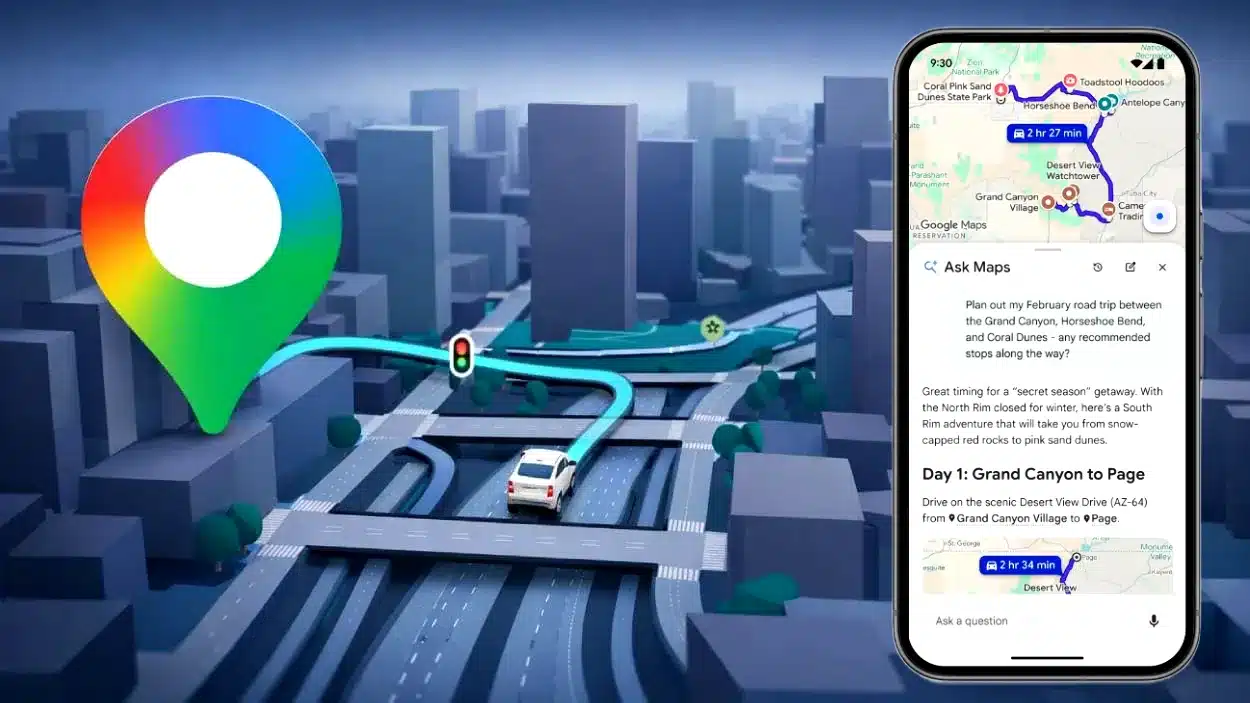
The first tool, Maps Imagery Grounding, makes it possible to anchor generative AI images in real-world Google Street View scenes. According to Google, the feature is currently available only as a private preview and only for locations in the United States.
Google says the tool is aimed at use cases such as film production and creative agencies. Instead of organizing time-consuming location scouting, users can describe a scene in the Gemini Enterprise Agent Platform with a text prompt and generate a visualization tied to a specific real-world place.
Google’s example is a film studio entering the prompt: “generate an image of a futuristic spaceship hovering in front of the Washington Square Arch.” Within seconds, the system produces an image grounded in the actual visual characteristics of that location. With Google’s Veo video model, those scenes can also be animated.
Satellite analysis in minutes instead of weeks
The second update is Aerial and Satellite Insights, a new capability inside Google Earth AI. Google says it will become available in the coming weeks and will allow aerial and satellite image analysis directly in BigQuery on Google Cloud.
According to Google, data analysts and city planners currently have to review thousands of satellite images manually to track changes in landscapes and urban areas. The new system is intended to reduce that process from weeks to minutes. One example Google gives is monitoring active construction sites in residential areas so planners can allocate resources for new roads and power infrastructure more efficiently.
Google is also introducing two new Earth AI imagery models, which are available experimentally in Google Cloud’s Model Garden. These models are trained to identify specific objects in images, including bridges, roads, and power lines. The idea is to let companies build their own geospatial products without spending months training specialized AI models from scratch.
All three features are still in early availability stages. Maps Imagery Grounding is only accessible through application as a private preview, the Earth AI imagery models are labeled experimental, and Aerial and Satellite Insights have not launched yet and are expected in the coming weeks. Companies interested in these geospatial analysis tools can apply for early access.
 ES
ES  EN
EN