
Until now, Chrome’s Autofill helped users enter addresses or credit card details. Auto Browse goes much further, promising to handle entire workflows. Google says testers have already used the feature to research hotel and flight prices across different travel dates, schedule appointments, fill out online forms, collect tax documents, request quotes from contractors, verify invoices, submit expense reports, and manage subscriptions. With access to Google’s password manager, the agent can also operate on websites that require login.
Whether Auto Browse can truly fulfill these promises remains to be seen. In December, The Verge published an extensive test of various AI browsers and reached a sobering conclusion: none of the agents reliably completed complex tasks. Users had to repeatedly refine their prompts, and even simple actions like finding relevant emails or ordering shoes often required constant corrections.
Gemini 3 introduces multimodal capabilities. If users upload a photo of party decorations, Auto Browse can search for similar products, add them to the cart, respect a predefined budget, and apply available discount codes. For these purchases, Google relies on the Universal Commerce Protocol (UCP) — an open standard for AI agents in e-commerce developed together with Shopify, Etsy, Wayfair, and Target. UCP aims to provide a universal interface for product search, purchasing, and customer support.
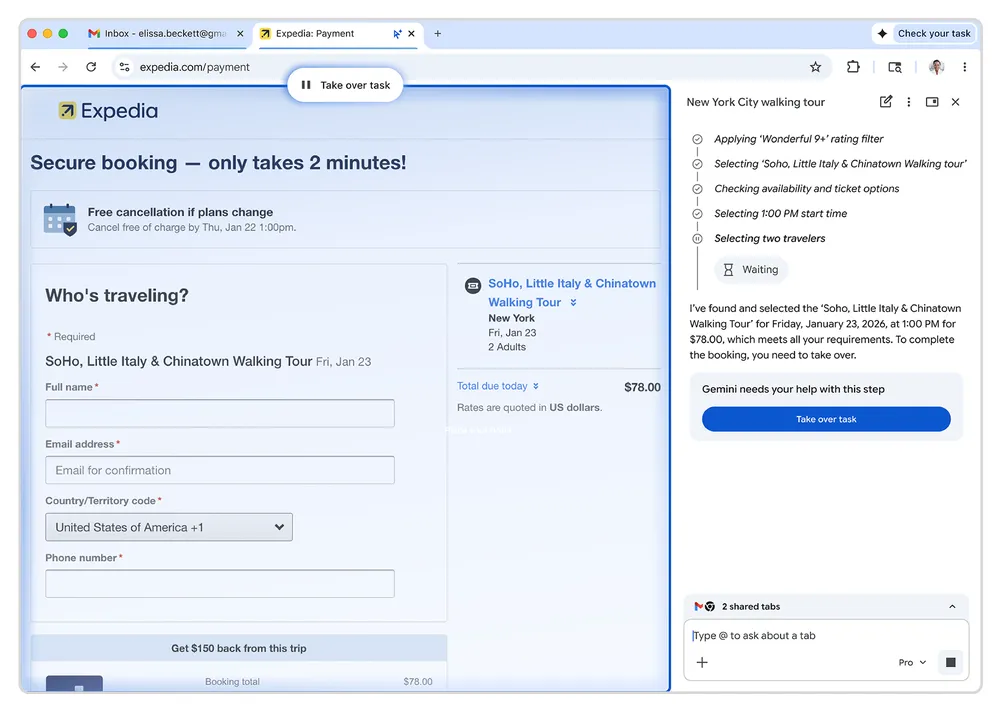
Auto Browse pauses before sensitive actions and asks for user confirmation before completing purchases or posting on social media. Google says it has developed new security mechanisms to defend against threats associated with agentic systems.
Auto Browse is initially available only in the United States, and only to paying subscribers of AI Pro ($21.99/month) or AI Ultra ($274.99/month).
Gemini and Nano Banana arrive in Chrome’s side panel
Google is also introducing a new side panel that permanently embeds Gemini into the browser. The panel stays open while users work in other tabs, allowing tasks such as summarizing product reviews across multiple websites or finding available calendar slots.
With Nano Banana, users can edit images directly inside the browser. They simply upload a photo and modify it using text prompts — without downloading the file.
Deep integration with Google services
Gemini in Chrome connects with Gmail, Calendar, YouTube, Maps, Google Shopping, and Google Flights. The assistant can retrieve old emails with conference details, suggest suitable flights, and draft messages to colleagues with arrival times.
In the coming months, Google plans to introduce Personal Intelligence in Chrome. This feature will store conversational context to deliver more personalized responses.
Agentic Vision in Gemini
Alongside its browser updates, Google also introduced Agentic Vision — a new capability that enables more detailed and adaptive analysis of visual content in AI-agent mode.
According to the company, next-generation large language models such as Gemini typically process visual information in a single static pass. If they miss fine details — such as a serial number on a microchip or a distant road sign — they tend to rely on inference rather than direct inspection.
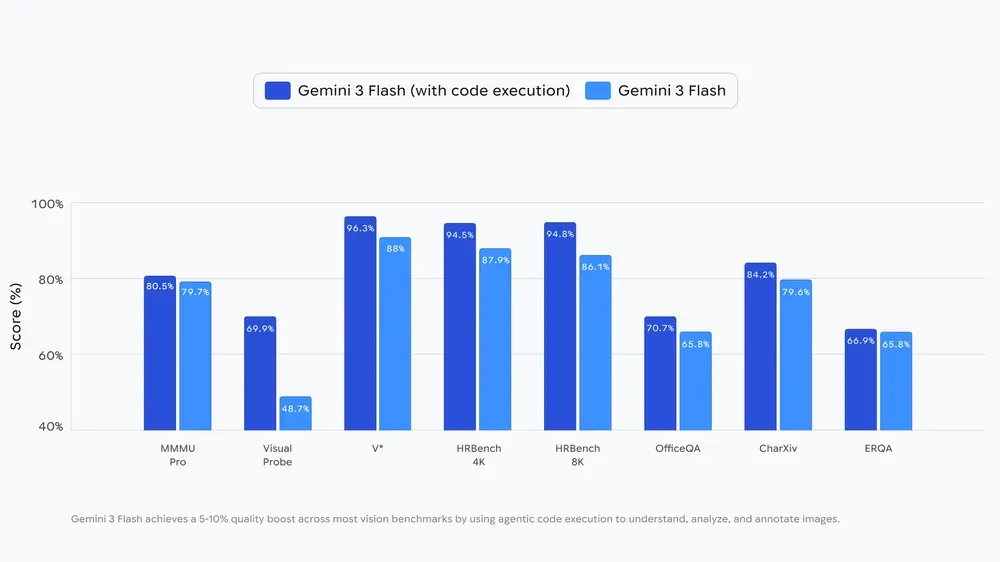
Agentic Vision in Gemini 3 Flash transforms image understanding from a static process into an active, step-by-step investigation. The model behaves like a human analyst:
-
assesses the overall scene;
-
identifies priority areas;
-
formulates a hypothesis-testing plan;
-
closely examines fine-grained details.
As a result, recognition accuracy improves by 5–10%, according to Google.
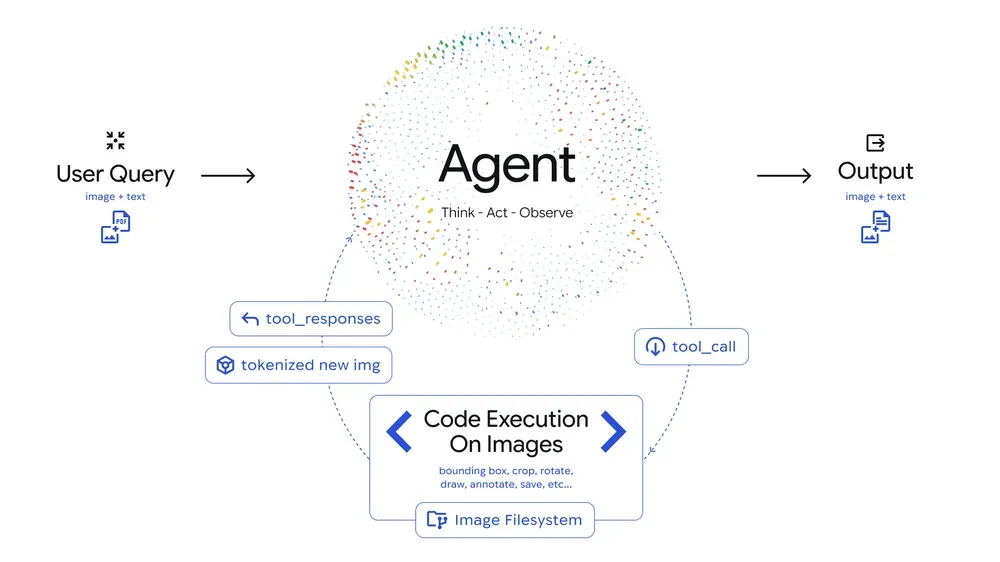
Agentic Vision introduces a “think–act–observe” loop into visual understanding tasks:
-
Think — the AI analyzes the user query and the original image, building a multi-step plan;
-
Act — the model generates and executes Python code to manipulate the image (cropping, rotation, zooming);
-
Observe — the transformed image is added back into the model’s context window for further inspection.
Gemini 3 Flash is trained to automatically zoom into images when detecting small or ambiguous details.
The beta version of Agentic Vision is now available for free in Google AI Studio, Vertex AI, the Gemini API for developers, and in the Gemini chatbot using Thinking mode.
Conclusion:
Auto Browse signals Google’s push toward fully agentic browsing, where AI handles complex online workflows end to end. If reliability and security challenges are addressed, such assistants could fundamentally change how users interact with the web, shifting browsers from passive tools into active digital operators.
 ES
ES  EN
EN