
Behind the internal name Nano Banana 2 is Gemini 3.1 Flash Image. With three models now in the Nano Banana family, Google is trying to clarify which version developers and creators should choose for different tasks.
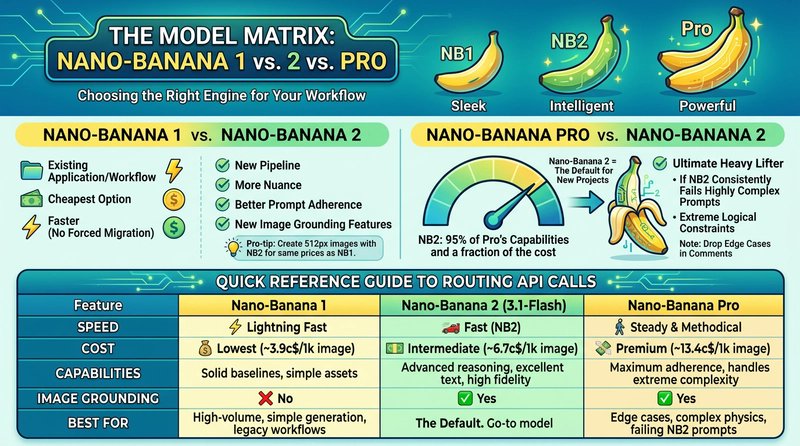
Nano Banana 2 is meant to be the default option
According to Google, Nano Banana 2 delivers roughly 95% of the capabilities of the more expensive Nano Banana Pro, but at a much lower cost. For most new projects, Google recommends NB2 as the standard choice.
Pricing by output resolution is listed as follows:
-
0.5K: NB2 costs $0.045, while Pro is not available;
-
1K: NB2 costs $0.067, compared with $0.134 for Pro;
-
2K: NB2 costs $0.101, versus $0.134 for Pro;
-
4K: NB2 costs $0.151, versus $0.240 for Pro.
Google says developers should only move up to Nano Banana Pro for very complex, multi-layered prompts or tasks with unusually demanding logical requirements that NB2 cannot handle. That still leaves Pro as the company’s top-tier image model.
The older Nano Banana 1 remains the cheapest and fastest option, since it is not a so-called thinking model. Google is not forcing users to migrate away from it.
Still, for anyone building new pipelines that require more nuance, stronger prompt adherence, or new grounding features, Google recommends going directly to NB2. A practical detail is that generating 512-pixel images with NB2 costs about the same as using NB1.
Web image search is NB2’s standout feature
The most important new capability in Nano Banana 2 is visual grounding with Google Search.
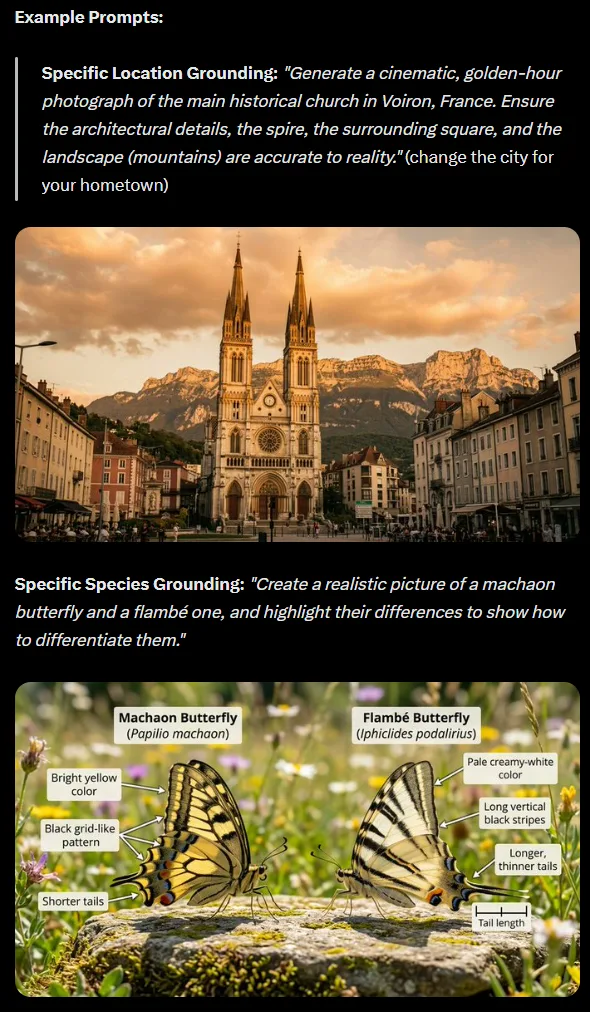
While Nano Banana Pro could already retrieve text-based information from the web, NB2 goes a step further by being able to search for images online in order to better understand how real-world objects look before generating them.
Google says this image grounding feature works especially well for specific places such as churches, bridges, or city squares, as well as for distinguishing exact animal and plant species. The company demonstrated the feature using a church in Voiron, France, and by showing how the model could visually differentiate between two butterfly species.
The feature does not work for people.
At the moment, image grounding appears to be available only through the API, not inside the Gemini app. Google points developers to implementation details in its documentation and an official Python Colab notebook.
New resolutions and extreme aspect ratios aim to reduce costs
Nano Banana 2 can also generate images at 512-pixel resolution, which speeds up generation and lowers cost to roughly the level of Nano Banana 1.
Google recommends a multi-step workflow: use the Batch API, which offers a 50% discount, to generate dozens of 512px variations first, then upscale the best composition to 1K, 2K, or 4K.
NB2 also introduces support for extreme aspect ratios such as 1:8 and 1:4, in both vertical and horizontal formats. Google says these formats are useful for web banners, scroll-based content, or comic-style layouts in the Franco-Belgian tradition.
Compared with Nano Banana Pro, NB2 offers:
-
Max input tokens: 131,072 vs. 65,536;
-
Max output tokens: 32,768 for both;
-
Resolutions: 0.5K, 1K, 2K, 4K for NB2 vs. 1K, 2K, 4K for Pro;
-
Aspect ratios: standard formats plus 1:4, 4:1, 1:8, and 8:1 for NB2;
-
Text grounding: yes on both;
-
Image grounding: yes on NB2, no on Pro;
-
Reference image inputs: up to 14 on both;
-
Document inputs: text and PDF on both;
-
Outputs: text and images on both;
-
Knowledge cutoff: January 2025 on both;
-
Real-time web search: yes on both;
-
Safety standards: C2PA content credentials and SynthID watermarking on both.
Google also gave guidance on the model’s thinking mode. The company says it should remain off by default, because for ordinary image generation it mainly adds time and compute cost. It should only be enabled in three situations: when the model produces nonsensical results, when creating highly complex infographics, or when combining image grounding with spatial reasoning.
Conclusion
Google is clearly positioning Nano Banana 2 as the new mainstream option for image generation inside the Gemini stack. By combining lower costs with broader capabilities such as visual grounding and extreme aspect ratios, the company is trying to make advanced image workflows more practical for everyday developer use.
 ES
ES  EN
EN