
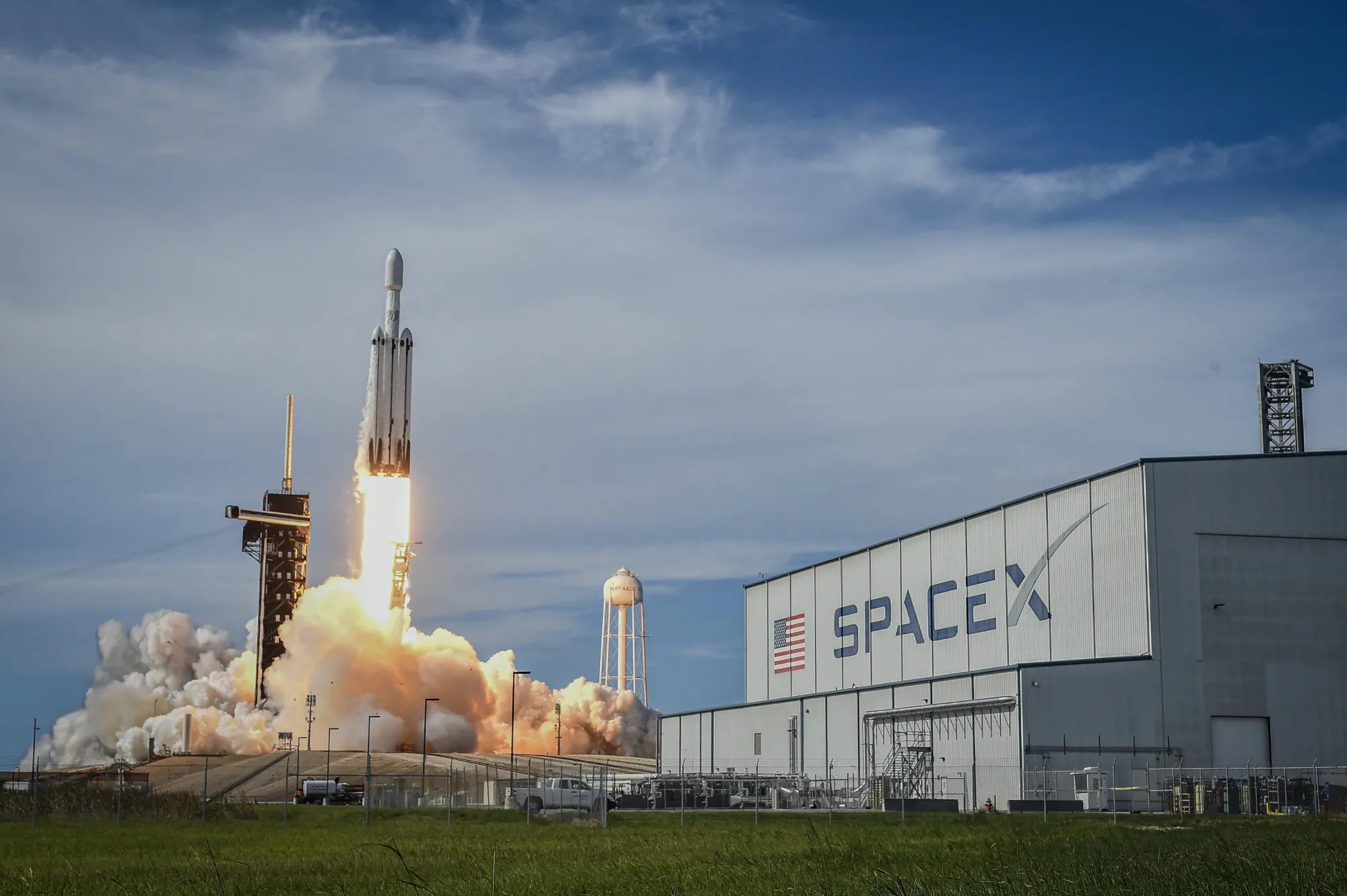
Musk said the merger is aimed at building data centers beyond Earth.
“Modern advances in artificial intelligence depend on massive terrestrial data centers that require enormous amounts of energy and cooling. Global electricity demand simply cannot be met on Earth without harming people and the environment,” he wrote.
According to Bloomberg News, the combined company is valued at $1.25 trillion. SpaceX plans to go public in 2026. As part of the deal, SpaceX was valued at $1 trillion, while xAI was valued at $250 billion.
Bloomberg reports that both of Musk’s companies are facing financial pressure, although SpaceX’s position is significantly stronger.
SpaceX generates up to 80% of its revenue from Starlink satellite launches. In 2025, the company reported $8 billion in profit on $15–16 billion in revenue.
By contrast, xAI is spending around $1 billion per month. The AI startup has also faced investigations worldwide after allowing the generation and distribution of explicit content on X.
Musk said that building space-based data centers would require continuous satellite launches, creating an additional and sustained revenue stream for SpaceX.
In February, SpaceX filed a request with the U.S. Federal Communications Commission (FCC) seeking permission to deploy up to one million satellites for orbital data centers. The company is widely believed to understand that regulators will not approve a network of that scale and is using the figure as a negotiating starting point.
The proposal envisions a network of low-Earth-orbit data centers connected via laser links. The filing uses ambitious language, describing the project as a “first step toward a Type II civilization on the Kardashev scale.”
“In my estimation, within two to three years the most cost-effective way to perform AI computing will be in space. The price-to-performance ratio alone will allow innovative companies to advance neural network training and data processing at unprecedented speed and scale, accelerating breakthroughs in our understanding of physics and the invention of technologies for the benefit of humanity,” Musk wrote.
Space as a new frontier
Space is increasingly being viewed as an attractive location for data centers. Key advantages include near-unlimited access to solar energy and vast physical space for hardware deployment. The main drawback remains the high cost of rocket launches and supporting infrastructure.
Analysts at research group 33FG estimate that orbital AI computing could become economically viable by 2030.
Google is among the first major companies to explore this direction. The company has announced plans to build a low-Earth-orbit satellite network designed to collect solar energy and power data centers.
The proposed system would operate in a sun-synchronous orbit, remaining almost constantly exposed to sunlight and maximizing energy generation.
Google is also investing in fusion energy control, developing AI technology in collaboration with Commonwealth Fusion Systems. The project aims to create AI agents capable of controlling plasma inside the SPARC fusion reactor and optimizing its operation, with the ultimate goal of achieving a virtually limitless source of clean energy.
Conclusion
The SpaceX–xAI merger highlights how AI ambitions are increasingly converging with space infrastructure. While orbital data centers promise scalable computing, continuous solar energy, and long-term advantages for AI development, the strategy also introduces major regulatory, financial, and environmental challenges. If Musk’s vision proves viable, space could become a core pillar of future AI infrastructure—but the path there will require overcoming unprecedented technical, economic, and governance hurdles.
 ES
ES  EN
EN