
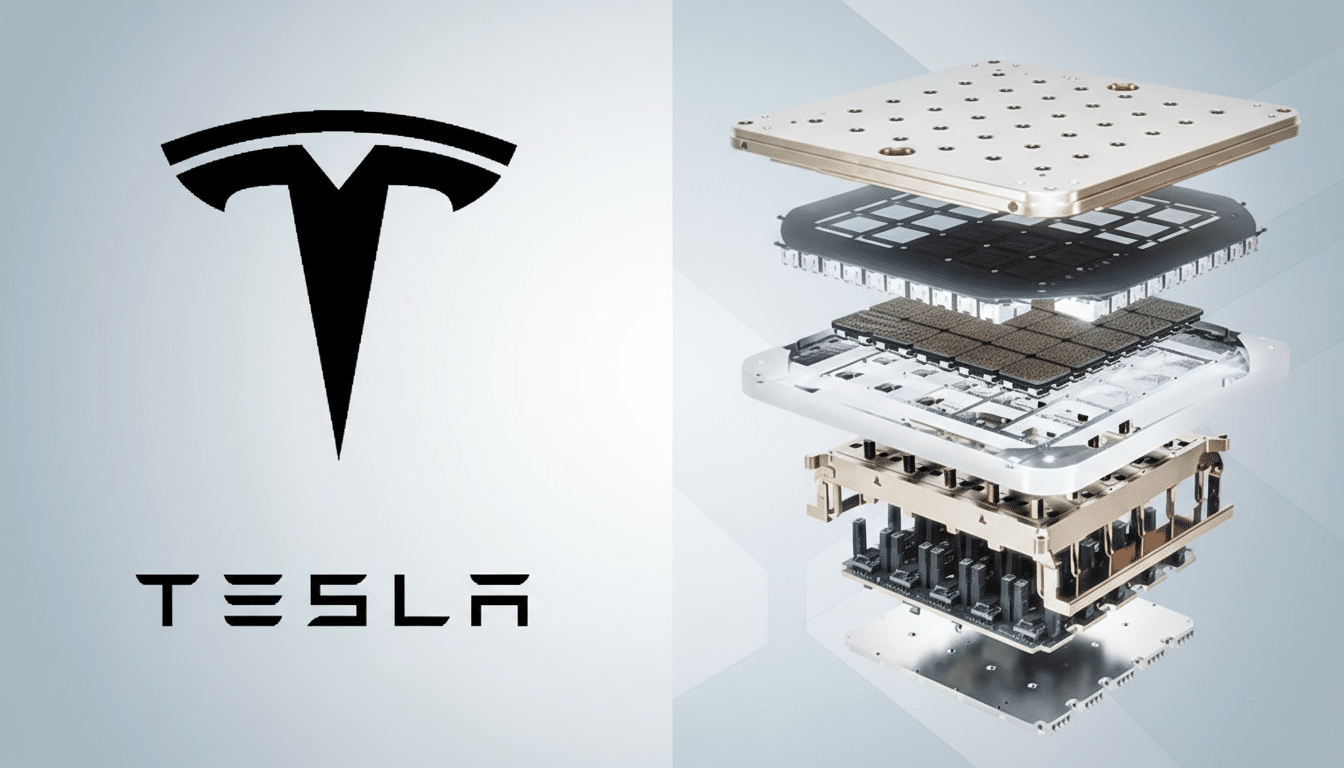
Dojo is Tesla’s specialized supercomputer and computing platform designed to train neural networks on massive volumes of video and sensor data.
The project was first announced in April 2019, when Tesla unveiled its in-house autopilot chips. At the time, Musk positioned Dojo as a core pillar of Tesla’s AI strategy and actively promoted the initiative in subsequent years.
The project’s trajectory has been turbulent. As recently as July 2024, ahead of the robotaxi presentation, Musk promised to “double down” on Dojo. However, in August 2025, he unexpectedly announced the shutdown of the effort and disbanded the team. Despite earlier plans to release Dojo 2 in 2026, he later described the project as an “evolutionary dead end.”
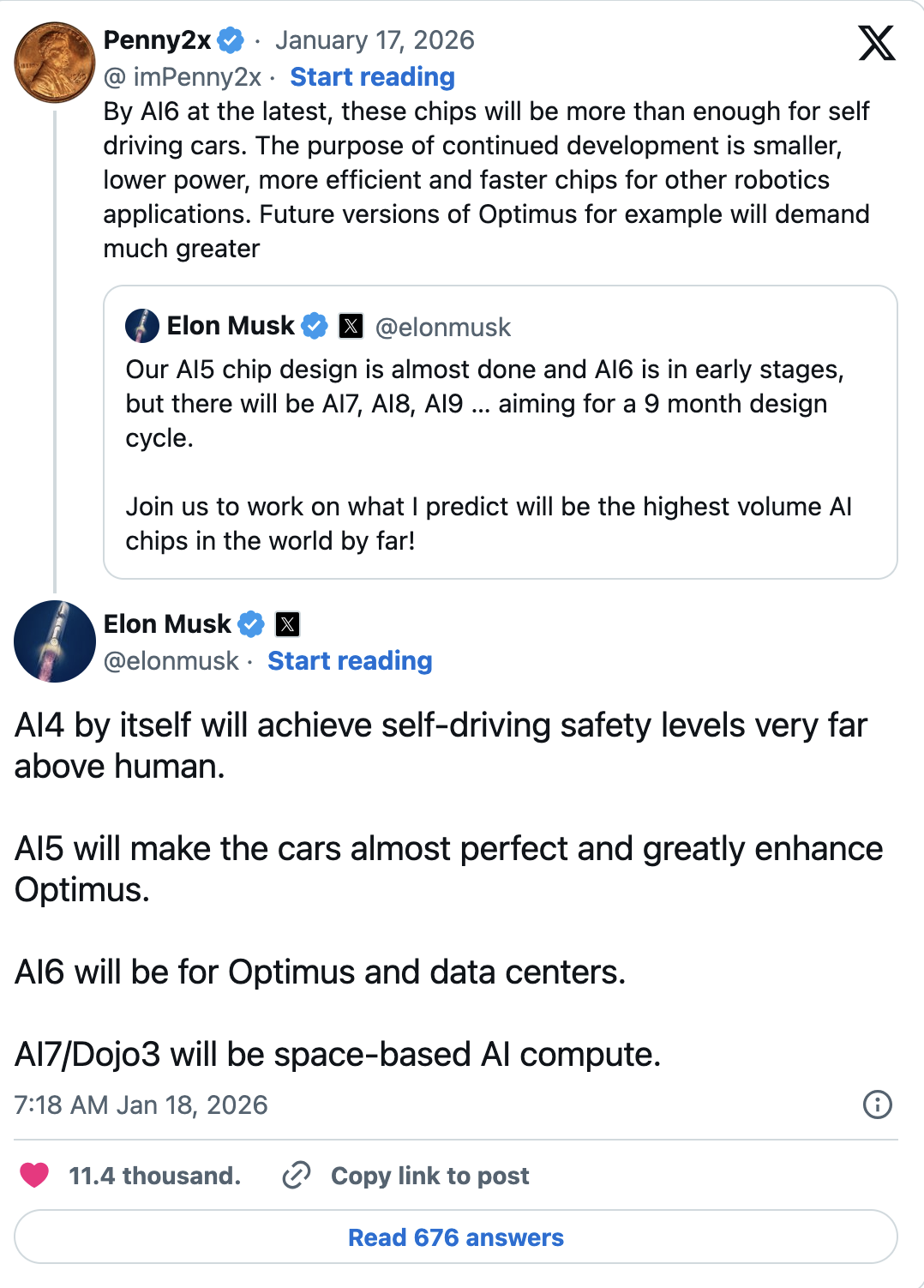
Now, Tesla is setting far more ambitious goals for Dojo.
“AI7/Dojo3 will be designed for AI-based space computing,” Musk stated.
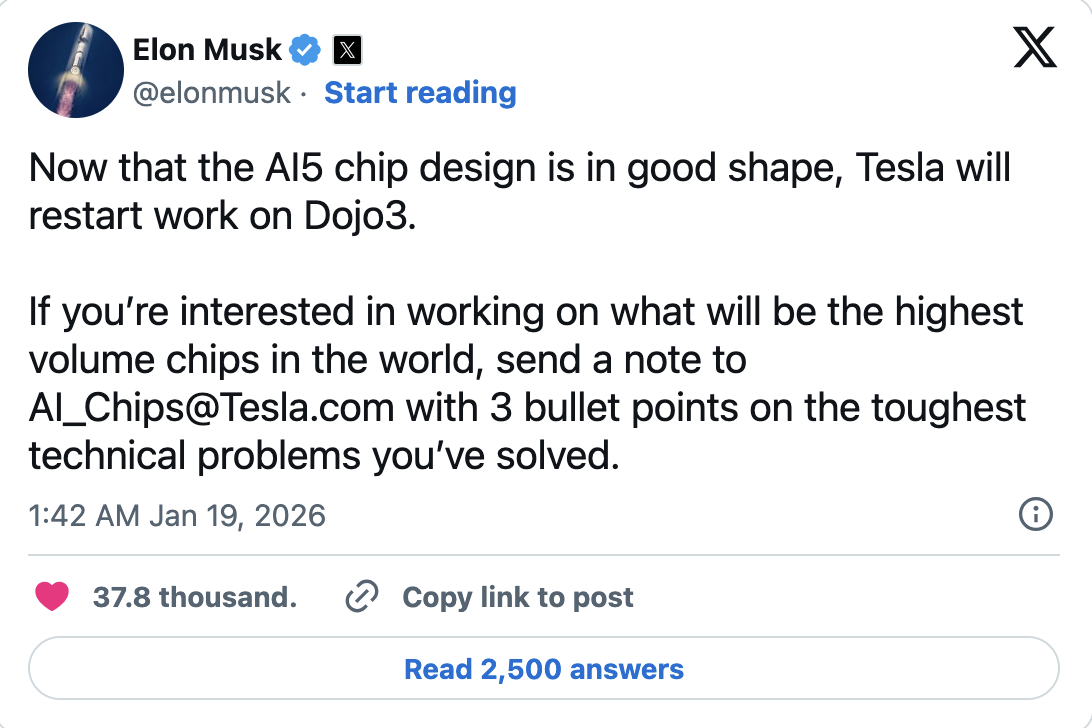
Tesla is preparing to reassemble the team that was dissolved several months ago.
“If you’re interested in working on chips that will be the most widely used in the world, emailThis email address is being protected from spambots. You need JavaScript enabled to view it. with three points describing the hardest technical problems you’ve solved,” Musk added.
Space as the next frontier
Musk and several other tech executives believe the future of data centers lies beyond Earth, arguing that the planet’s power grids are approaching their limits.
Key advantages include virtually unlimited access to solar energy and physical space for hardware deployment. The main drawback is the high cost of rocket launches and supporting infrastructure.
Analysts at research group 33FG estimate that orbital AI computing could become economically viable by 2030.
Google was among the first to signal interest, announcing plans to build a network of satellites in low Earth orbit to generate energy for powering data centers.
The idea is also supported by OpenAI CEO Sam Altman, but Elon Musk has a strategic edge—control over launch capabilities.
Musk plans to use a future SpaceX IPO to finance the concept, leveraging Starship to deploy clusters of computing satellites that could operate in constant sunlight and generate power around the clock.
From an industry perspective, Musk’s pivot of Dojo3 toward space-based AI computing is less a marketing stunt than a strategic hedge against Earth-bound energy constraints. If Tesla can truly combine in-house AI silicon, orbital solar power, and SpaceX’s launch dominance, it would represent a rare case where vertical integration creates a defensible advantage in next-generation compute infrastructure rather than just another speculative vision.
 ES
ES  EN
EN