

The new release expands the Flux-2 family, first introduced in November, with two main variants: a 9-billion-parameter flagship model and a leaner 4-billion-parameter version designed for broader use. Both are also available as undistilled base variants intended for research and fine-tuning.
Local generation and editing on consumer GPUs
According to Black Forest Labs, Flux 2 klein unifies three capabilities in a single model: text-to-image generation, image editing, and multi-reference generation, which allows multiple input images to be combined into new compositions.
While this combination is not entirely new—the foundation was laid with the Flux 1 Kontext model less than a year ago—what sets Flux 2 klein apart is that this unified architecture is now available in a compact model that runs on consumer hardware. Black Forest Labs states that the 4B model requires only 13 GB of VRAM and can operate on GPUs such as the Nvidia RTX 3090 or RTX 4070.
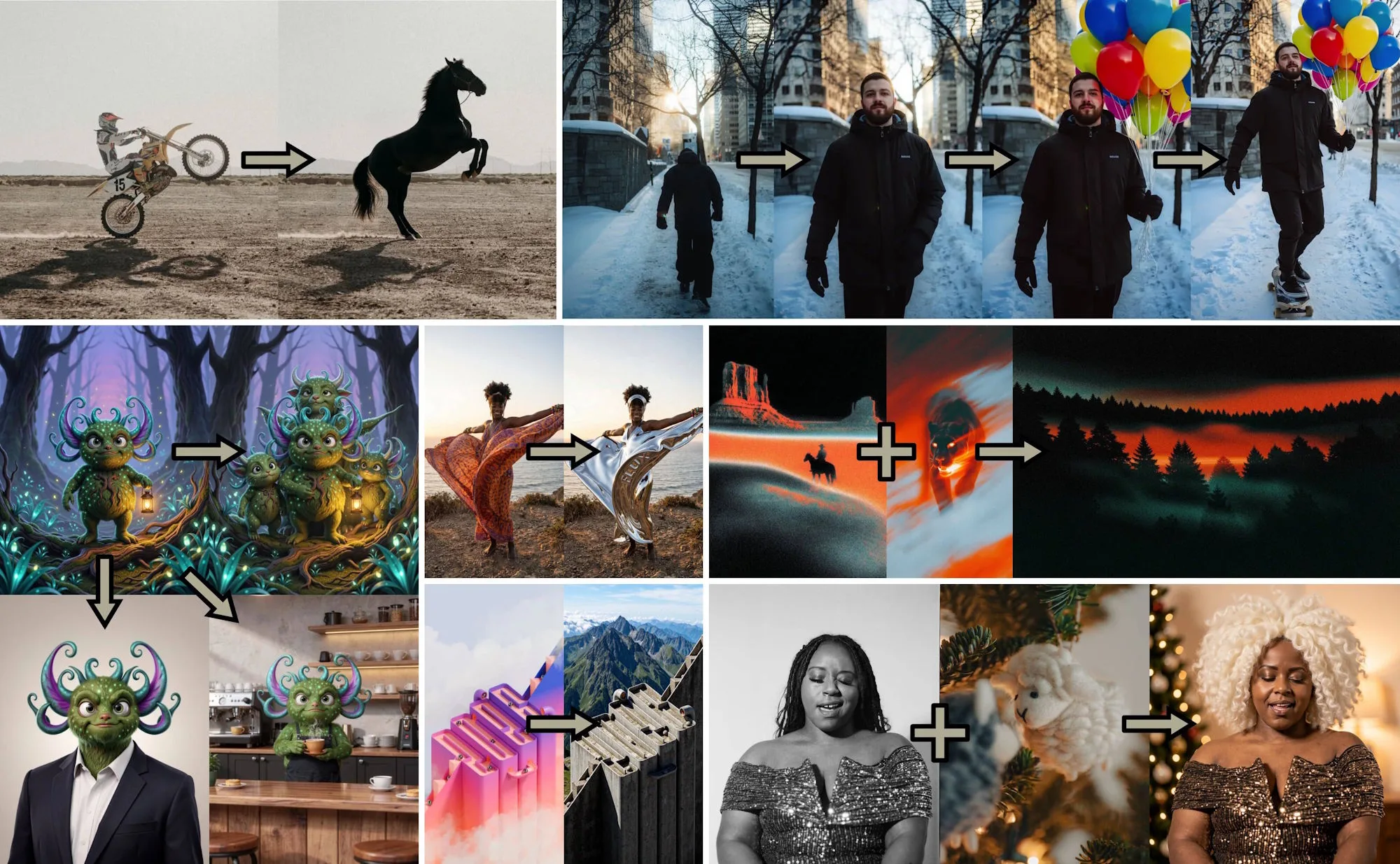
Before-and-after comparisons of AI image editing demonstrate targeted object replacement, the addition of new elements, and style combinations. Backgrounds and objects can be selectively modified or recombined.
Speed claims with caveats
The 9B model uses a so-called flow architecture and has been optimized to generate images in just four inference steps. Black Forest Labs claims generation times of under 0.5 seconds, although this measurement was taken on Nvidia’s GB200, a professional server-class chip, not on consumer GPUs.
In addition to the standard models, Black Forest Labs—working with Nvidia—has developed quantized versions. Quantization stores model weights at lower precision, reducing both memory usage and compute requirements.
-
The FP8 variant (8-bit floating point) is said to be up to 1.6× faster while using up to 40% less VRAM.
-
The NVFP4 variant uses Nvidia’s proprietary 4-bit floating-point format, enabling up to 2.7× speedups with up to 55% lower memory consumption.

These benchmarks were measured on the latest RTX 5080 and RTX 5090 GPUs.
In internal Elo comparisons, Black Forest Labs positions the 9B model as Pareto-optimal in terms of quality-to-latency ratio. The company claims it matches or exceeds Qwen’s quality at a fraction of the latency and VRAM usage and outperforms Z-Image. It also asserts that the 9B model surpasses models five times larger. These claims have not been independently verified.
Extensive safety measures documented
In its Hugging Face documentation, Black Forest Labs details the safety measures implemented. Training data was filtered in advance for NSFW content and known child sexual abuse material (CSAM). The company says it collaborates with the UK-based Internet Watch Foundation in this process.
Post-training, the models underwent multiple rounds of targeted fine-tuning to mitigate potential misuse scenarios. The repository includes filters for NSFW content in both inputs and outputs, as well as support for pixel-layer watermarking and the C2PA standard for content provenance.
Black Forest Labs also notes limitations: the model is not suitable for factual information, text rendering may be inaccurate, and prompt adherence depends heavily on prompt style.
Unicorn status after Series B
The release of Flux 2 klein comes amid rapid growth for the Freiburg-based company. In December 2025, Black Forest Labs closed a $300 million Series B round, valuing the startup at $3.25 billion. Founded in 2024, the company has now raised a total of $450 million. Flux models were previously available through xAI’s chatbot Grok, although Elon Musk’s AI firm has since developed its own photorealistic image model.
Black Forest Labs deliberately positions itself as an infrastructure provider for businesses rather than a consumer-facing app developer. The company has also announced plans to work on a competitive video generation model.
Licensing differs by model size: the 4B model is released under the Apache-2.0 license and can be used commercially without restriction. The more powerful 9B model is limited to non-commercial use; commercial deployment requires a separate license.
Black Forest Labs provides a reference implementation on GitHub. The model is also integrated into the popular workflow tool ComfyUI and the Diffusers Python library.
 ES
ES  EN
EN