
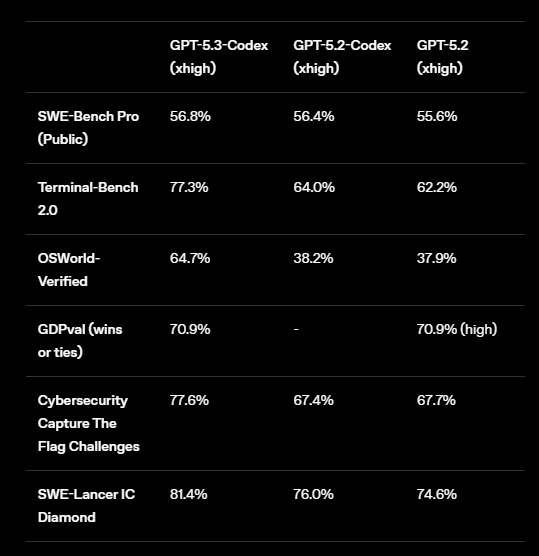
Across four performance benchmarks focused on programming and real-world applications, GPT-5.3-Codex achieves new industry-leading results, OpenAI says. On the agentic coding benchmark Terminal-Bench 2.0, Codex 5.3 outperforms the recently released Opus 4.6 by 12 percentage points—a substantial gap by current AI model standards. At the same time, the model consumes fewer tokens than previous Codex versions.
OpenAI also says the model helped accelerate its own development. The Codex team used early versions to identify training errors, manage deployment, and analyze test results. According to OpenAI, the team was surprised by how significantly Codex sped up its own creation.
GPT-5.3-Codex is available to paying ChatGPT users across all Codex environments, including the Codex app, CLI, IDE extension, and the web interface. API access is planned for a later release.
Notably, GPT-5.3-Codex is the first OpenAI model to be classified with a “High” cybersecurity risk rating. OpenAI describes this as a precautionary measure, stating that there is no definitive evidence of misuse, but that the designation reflects a conservative approach to risk management.
New enterprise platform
The releases did not stop there. OpenAI has unveiled a new enterprise platform called Frontier, which “acts as an intelligent layer that connects fragmented systems and data within an organization.”
The product is designed to make it easier for companies to manage, deploy, and build AI agents capable of autonomously performing tasks.
“Frontier is an acknowledgment that we won’t build everything ourselves. It’s better to work with the ecosystem and create together with it,” said Fidji Simo, OpenAI’s CEO of Applications.
OpenAI has been rapidly expanding in the enterprise market. In November 2025, the company reported surpassing 1 million corporate users.
In January 2026, OpenAI CFO Sarah Friar stated that the B2B segment accounts for roughly 40% of the company’s business.
The new platform complements existing business offerings such as ChatGPT Enterprise.
Frontier provides agents with access to a shared organizational context, connecting internal applications and tools across a company. This allows digital assistants to carry out complex tasks and analyze data across multiple systems.
 ES
ES  EN
EN