
Strong Earnings
The company posted Q1 revenue of $94.7 billion, ahead of the analyst consensus of $91.6 billion. Earnings per share came in at $5.11, well above Wall Street's expectation of $2.62. Alphabet shares rose more than 6%.
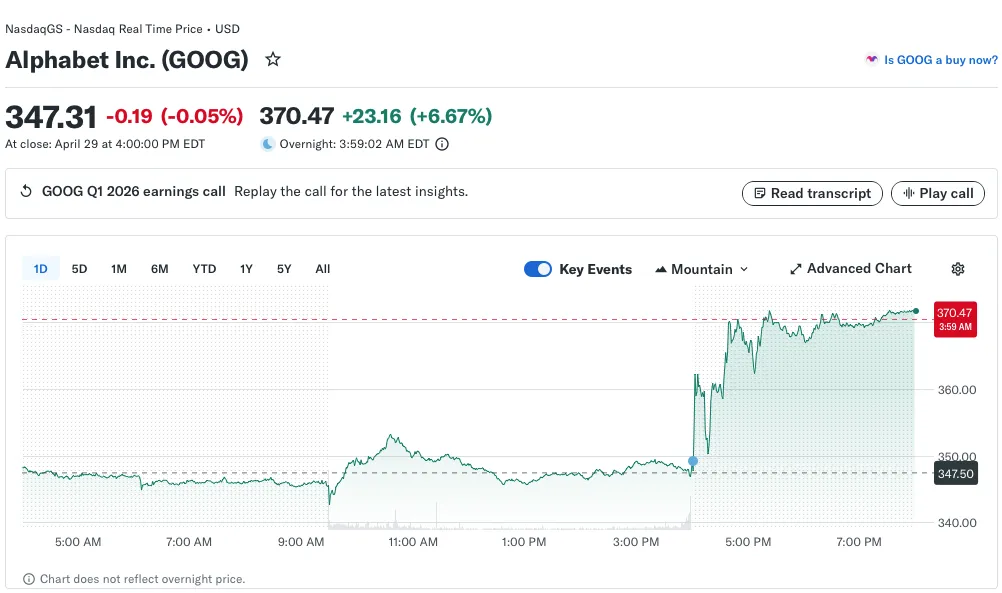
The results dispelled investor concerns about the future of Google's core business — search monetization. Rather than declining, the company is actively transforming this segment through AI.
The cloud segment continues to grow rapidly, driven by demand for AI software and infrastructure. The Gemini app and enterprise tools are gaining traction, and search query volumes hit a record high following the integration of neural networks.
"AI has improved search, not killed it," wrote Zacks Investment Research strategist Andrew Rocco.
In 2026, Alphabet plans to allocate up to $190 billion in capital expenditures, with spending set to increase further in 2027.
"These strong results reinforce our conviction in the need to invest in the capital required to continue capturing AI opportunities," said CFO Anat Ashkenazi.
Google CEO Sundar Pichai noted that the company has successfully reduced the cost of processing user queries using large language models (LLMs).
Cloud by the Numbers
Google's cloud division reported revenue of $20 billion — above the analyst forecast of $18.4 billion — and demonstrated "significant acceleration in growth" driven by demand for AI software and infrastructure.
The order backlog nearly doubled quarter-over-quarter, exceeding $460 billion.
"We faced compute capacity constraints. Cloud revenue could have been higher if we had met all the demand. We are working to address this and investing accordingly," Pichai said.
Google will also offer tensor processing units (TPUs) to select customers for use in their own data centers.
Demand for AI software remains strong. The number of active Gemini Enterprise paid subscribers grew 40% in the quarter. The Gemini chatbot had 750 million users as of the end of 2025.
New Product Releases
Alongside the financial results, Google unveiled a range of new AI products.
Google Photos
The service has introduced an AI-powered digital wardrobe feature. Users can create new outfit combinations and virtually try them on.
The tool uses AI to automatically build a wardrobe based on clothing available in a user's Google Photos library, with category filters for easy browsing.
Outfit ideas can be shared with friends or saved to a digital album — making it easy to plan looks for different occasions such as travel, events, dates, or work.
The update will roll out in summer — first on Android, later on iOS.
Google TV
The platform has received a suite of Gemini-powered AI features along with a short-video feed.
The centerpiece of the update is expanded Gemini functionality. A "Create" button unlocks experiments with Nano Banana and Veo. The former lets users transform photos using voice commands, while Veo generates video clips or animates still images.
Developers are positioning these tools as a new format for shared entertainment in the living room.
The TV Photos app has also been updated. Gemini's smart search helps users quickly find specific moments — such as photos from a particular holiday. The "Remix" feature stylizes images, while "Dynamic Slideshows" add animation, frames, and color effects. A new "Short Videos for You" section featuring YouTube Shorts content will also appear on the Google TV home screen.
Document Export in Gemini
The Gemini AI assistant can now generate and download ready-made files for Google Docs, Microsoft Word, and Excel.
Supported formats include: .pdf, .docx, .xlsx, .csv, LaTeX, Plain Text (.txt), Rich Text Format (.rtf), and Markdown (.md).
Google Translate
To mark the service's 20th anniversary, developers have introduced a pronunciation practice tool.
In the "Practice" menu, tapping the "Speak" button prompts the app to listen to the user, evaluate their speech, and provide feedback.
The feature is launching in the US and India, with initial support for English, Spanish, and Hindi.
 ES
ES  EN
EN