

According to the company, GPT-5.5 is designed to understand complex requests, use tools, verify its own results, and complete a wider range of tasks from start to finish.
The model can interpret user intent, plan workflows independently, and carry multi-step tasks through to a final result. OpenAI says GPT-5.5 performs especially well in coding, debugging, web research, data analysis, document and spreadsheet creation, software operation, and switching between tools.
“Instead of carefully supervising every step, you can give GPT-5.5 a complex multi-step task and rely on it to plan, use tools, check its work, handle ambiguity, and keep going,” OpenAI said in its announcement.
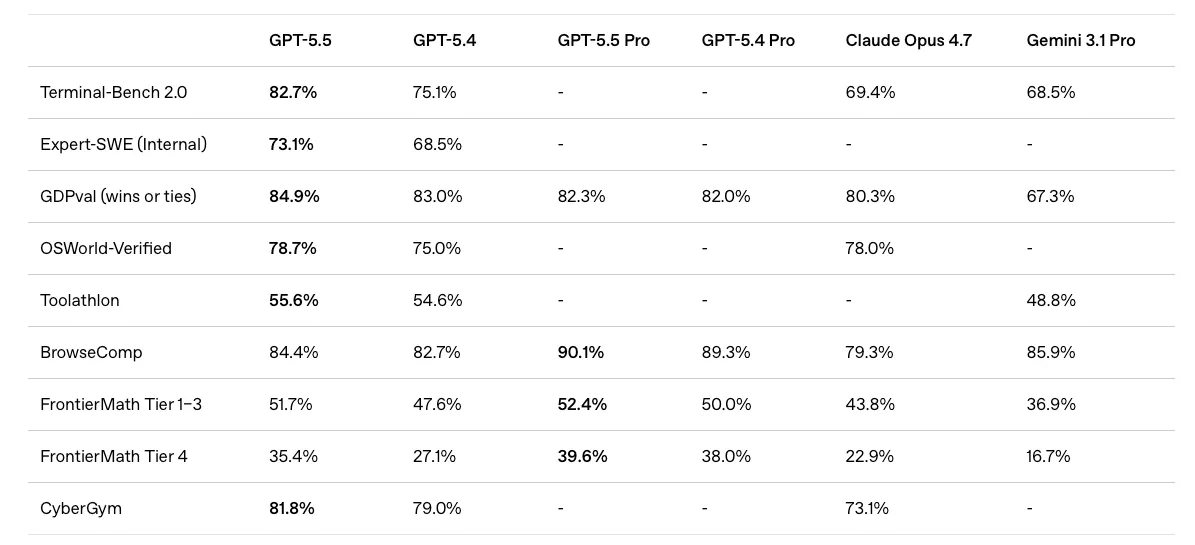
OpenAI highlighted several areas where the new model is particularly effective, including agentic coding, computer control, knowledge work, and early-stage scientific research. These are tasks that often require long chains of reasoning, tool use, and decision-making.
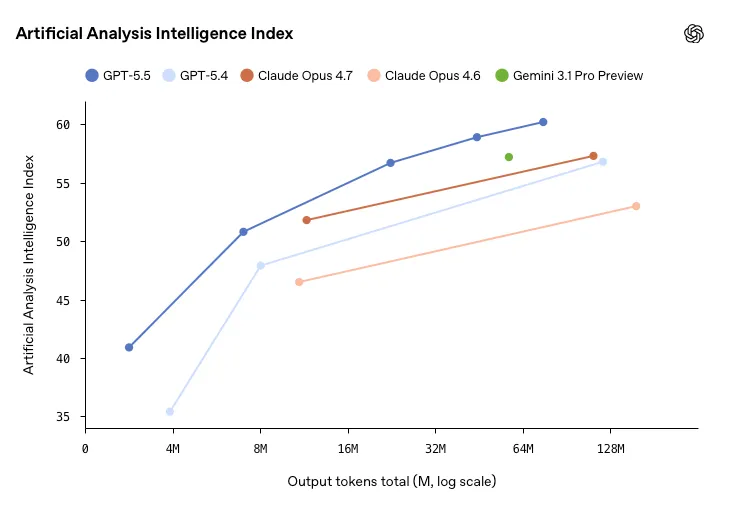
“GPT-5.5 delivers a leap in intelligence without sacrificing speed. Larger and more powerful models are often slower, but GPT-5.5 matches GPT-5.4 in real-world latency per token while demonstrating a much higher level of intelligence,” the company said.
The model also uses significantly fewer tokens when working inside Codex, according to OpenAI.
Before release, OpenAI said it applied its most advanced safety process to date, working with both internal teams and external experts.
Availability
GPT-5.5 is available in ChatGPT and Codex for users on Plus, Pro, Business, and Enterprise plans. A separate GPT-5.5 Pro version is available for Pro, Business, and Enterprise users.
Both versions are expected to become available through the API soon. Pricing is listed at $5 per 1 million input tokens and $30 per 1 million output tokens. The model supports a context window of up to 1 million tokens.
In Codex, GPT-5.5 is available to users on Plus, Pro, Business, Enterprise, Edu, and Go plans, with a 400,000-token context window. GPT-5.5 is also offered in Fast mode, where it generates tokens 1.5 times faster at 2.5 times the cost.
GPT-5.5 is more expensive than GPT-5.4, which OpenAI attributes to its higher token efficiency and stronger performance.
What GPT-5.5 Can Do
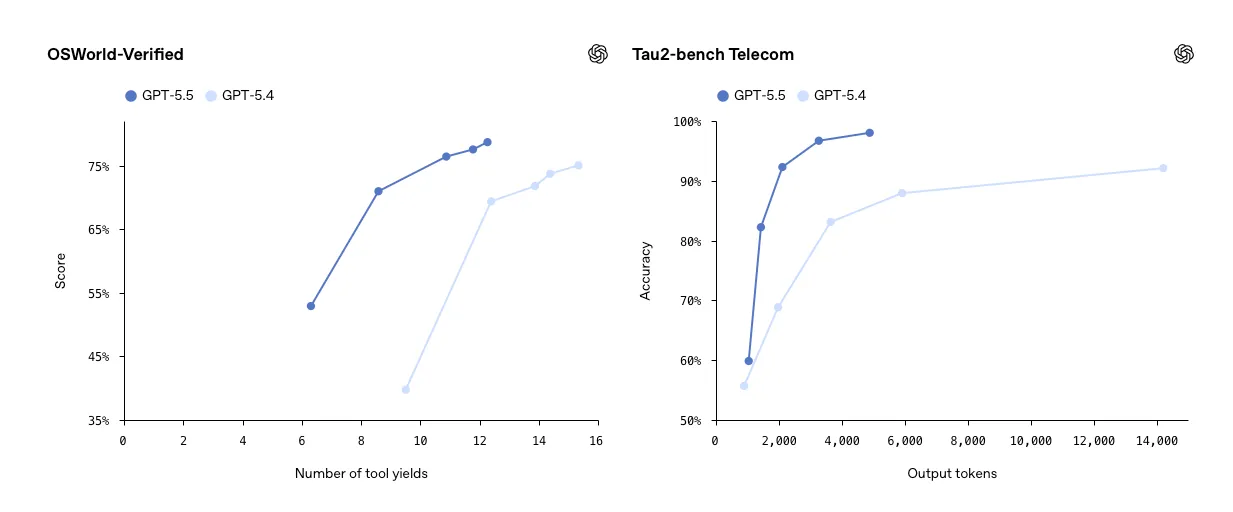
OpenAI says GPT-5.5 uses fewer tokens and needs fewer retries when solving difficult tasks. In the Artificial Analysis coding index, the model reportedly reaches frontier-level intelligence at about half the cost of competing models.
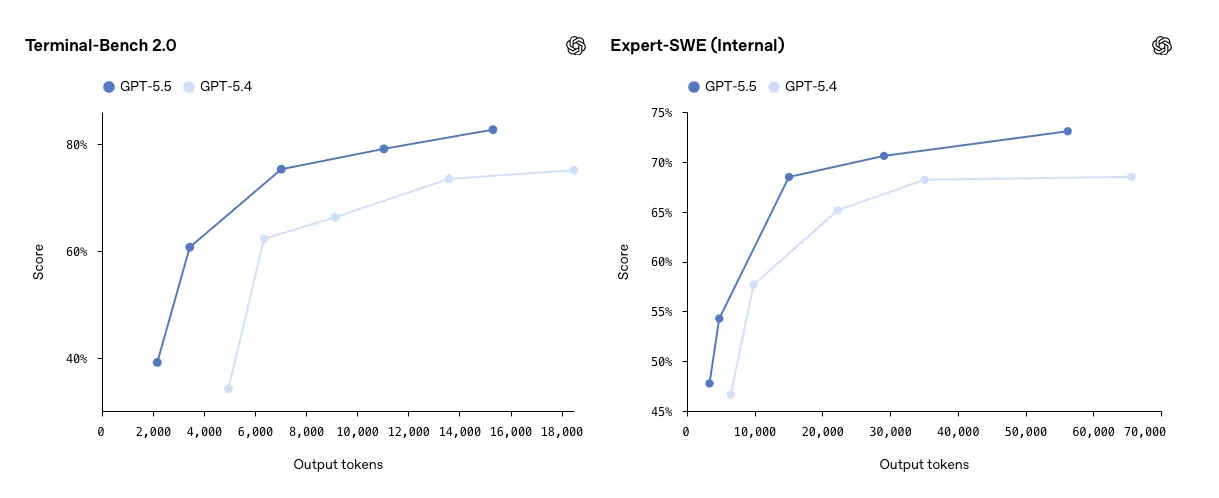
GPT-5.5 is OpenAI’s most capable model for agentic software engineering. In Terminal-Bench 2.0, a benchmark focused on complex command-line workflows, the model achieved 82.7% accuracy.
It scored 58.6% on SWE-Bench Pro and outperformed GPT-5.4 on Expert-SWE. Across all three benchmarks, GPT-5.5 surpassed its predecessor while using fewer tokens.
“The model’s strengths in coding are especially clear in Codex, where it can handle engineering tasks ranging from implementation and refactoring to debugging, testing, and validation,” OpenAI said.
GPT-5.5 is also better at understanding how systems work. It can identify why something fails, determine where changes are needed, and understand which parts of a codebase may be affected.
OpenAI says the model significantly outperforms GPT-5.4 and Claude Opus 4.7 in reasoning and autonomy. It can identify issues earlier, anticipate testing needs, and recognize when code review may be required without explicit instructions.
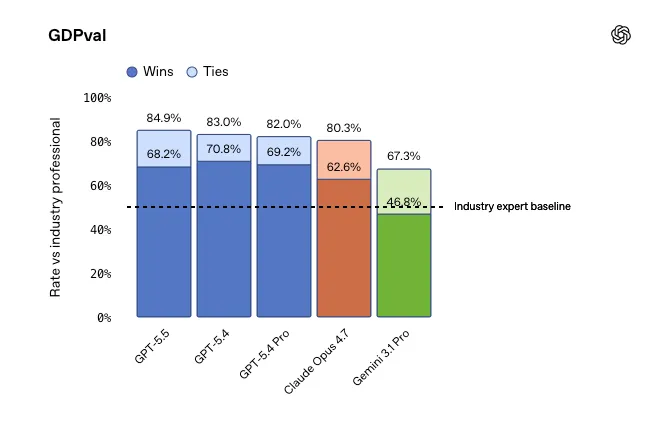
On GDPval, a benchmark that evaluates agents on clearly defined knowledge-work tasks across 44 professions, GPT-5.5 scored 84.9%. It also reached 78.7% on OSWorld-Verified and 98% on Tau2-bench
The model also posted strong results on other professional benchmarks, including 60% on FinanceAgent, 88.5% on internal investment banking modeling tasks, and 54.1% on OfficeQA Pro.
Working With Information
OpenAI describes GPT-5.5 as a powerful tool for everyday computer-based work. The model is designed to better understand what users want and to manage the full information workflow: searching, analyzing, using tools, checking results, and turning raw input into a finished output.
Inside Codex, GPT-5.5 outperforms GPT-5.4 in creating documents, spreadsheets, and slide presentations.
OpenAI also said that more than 85% of employees across its departments use Codex every week. This includes teams working in software engineering, finance, communications, marketing, data analysis, and product management.
Scientific Research
GPT-5.5 also shows stronger results in scientific and technical workflows. These tasks often go beyond answering a single question. Instead, the model needs to explore an idea, gather evidence, test a hypothesis, and interpret results.
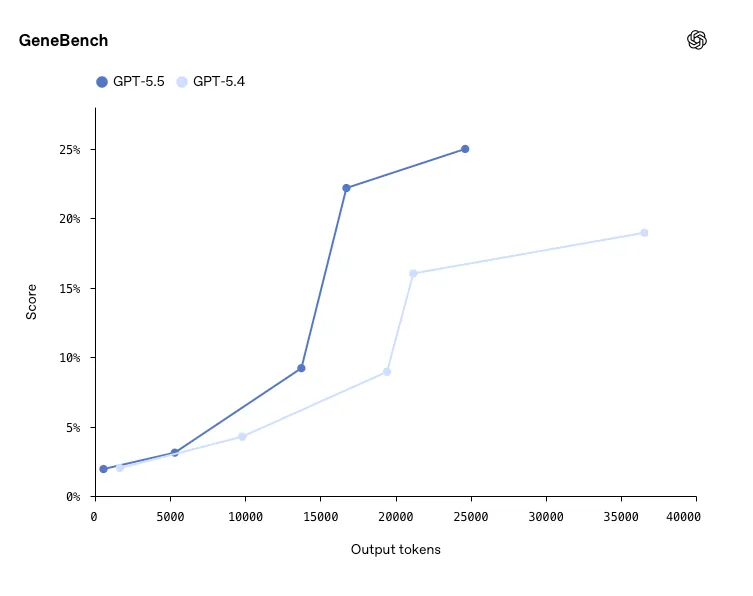
On GeneBench, a platform for multi-step scientific data analysis in genetics and quantitative biology, GPT-5.5 improved over GPT-5.4.
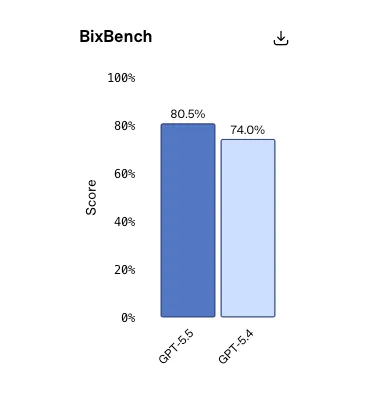
The new model also outperformed its predecessor on BixBench.
GPT-5.5 represents OpenAI’s continued push toward more autonomous AI systems that can manage complex workflows with less human supervision. For an English-speaking audience, the strongest angle is not just that the model is “smarter,” but that it is positioned as a practical work agent for coding, research, office productivity, and enterprise automation
The launch follows OpenAI’s April introduction of workplace agents in ChatGPT, which allow teams to create shared assistants for complex tasks and long-running workflows.
 ES
ES  EN
EN